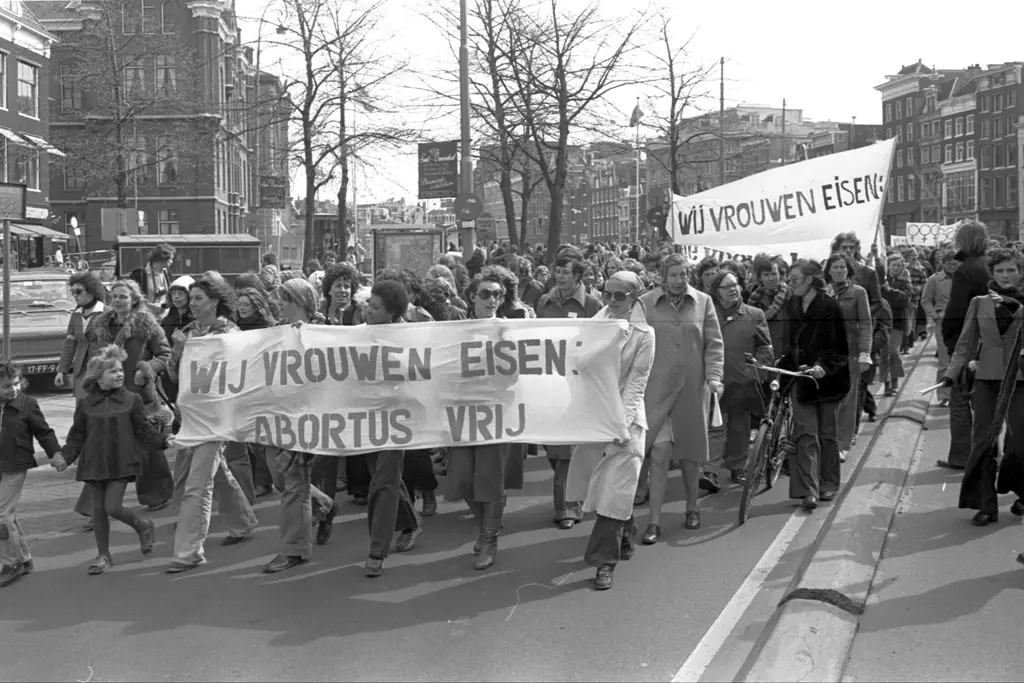
In the 1970s, debate on the legalisation of abortion* swelled. Demonstrations and other public actions kept the issue under the spotlight. The formation of the action group We Women Demand had an important role in this. Then finally, in 1984, the new Termination of Pregnancy Act came into force. Based on the sources below, these issues are highlighted in more detail.
In the 1970s, debate on the legalisation of abortion* swelled. Demonstrations and other public actions kept the issue under the spotlight. The formation of the action group We Women Demand had an important role in this. Then finally, in 1984, the new Termination of Pregnancy Act came into force. Based on the sources below, these issues are highlighted in more detail.
1972: Abortion demonstration Utrecht
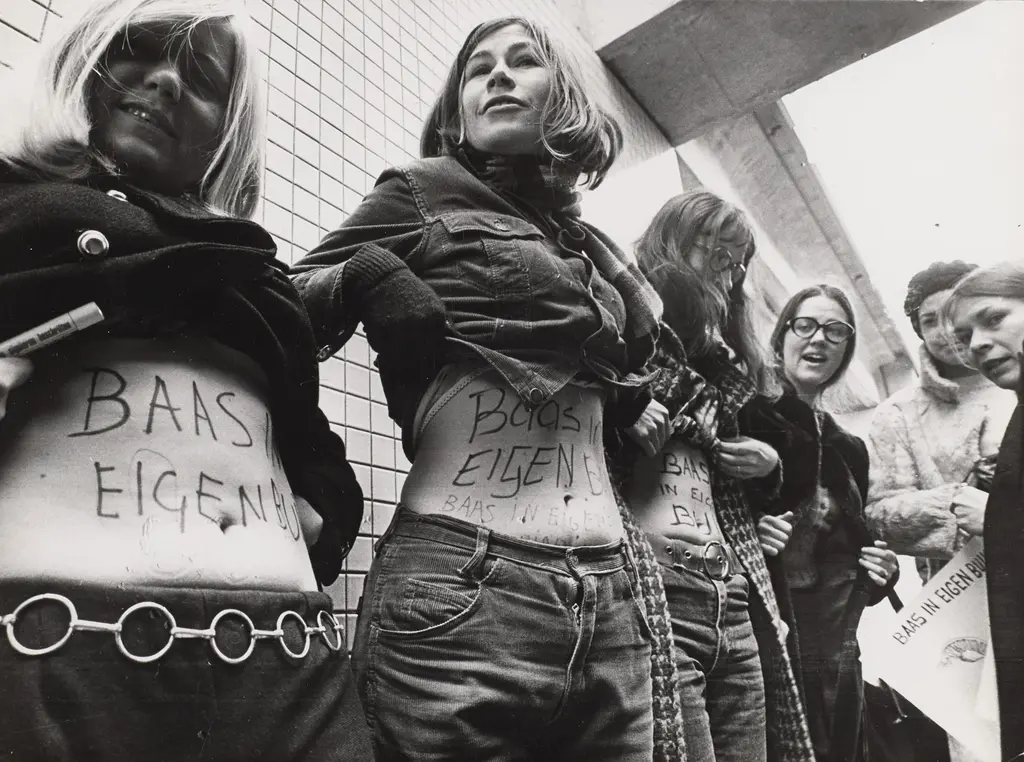
In 1972, the confessional parties came up with a conservative counterproposal to the bill proposed by PvdA MPs Lamberts and Roethof. Abortion would only be allowed for specific indications determined by experts. On 19 February 1972, Dolle Mina organised a large demonstration in Utrecht against this bill and for the legalisation of abortion. This attracted 20,000 people.
1972: Dolle Mina's covered wagon ride
To also reach the women** who did not come to a demonstration, the Dolle Mina's devised a plan. With a covered wagon they travelled across the Netherlands for a month. From the cart, they provided information on the political discussions about the abortion law. They also collected signatures and expressions of support. At the end of the march, the Dolle Mina's presented these to members of parliament. The march started on 15 April 1972 in Sevenum in Limburg and ended on 12 May in The Hague.
1973: Roe v. Wade (United States)
Across the ocean, in the United States, abortion became legal in 1973. Three years earlier, Jane Roe, alias of Norma McCorvey, had filed a lawsuit against Henry Wade, the Dallas County prosecutor. In 1973, the Supreme Court declared Texas' ban on abortion unconstitutional. It violated women's privacy rights. From then on, judges across the US could refer back to this Supreme Court ruling.
1974: The first Bloemenhove affair
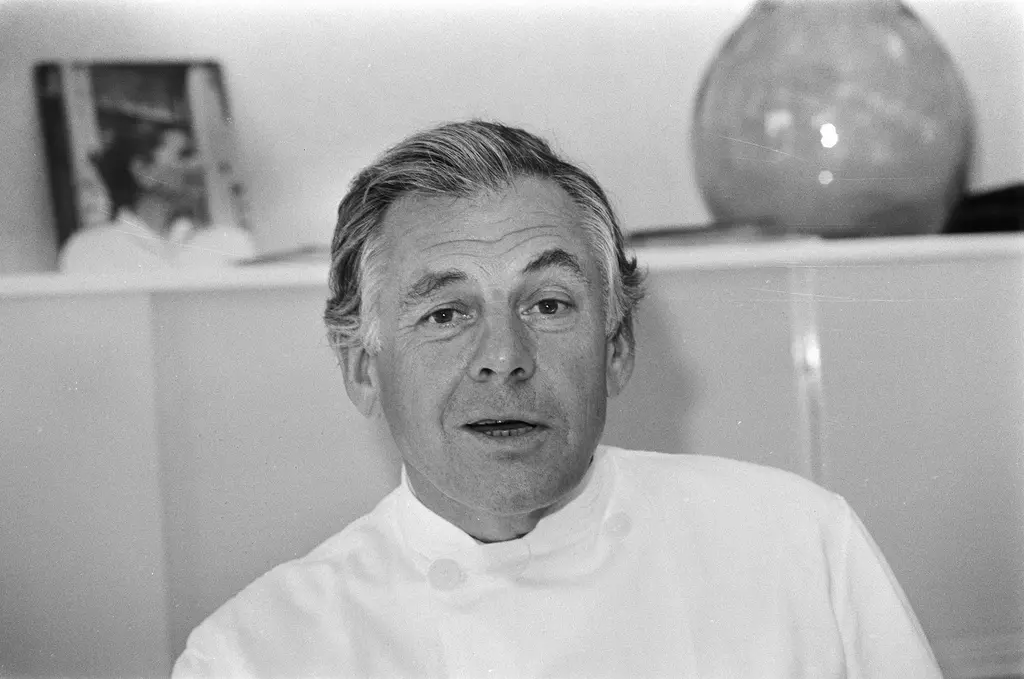
'I am against it, very much against the Minister of Justice in the Netherlands interfering with women and their problem in 1974.' This was emphasised by D66 politician and Stimezo board member Anneke Goudsmit in the parliamentary debate held at her request on 5 November 1974. This was in response to Justice Minister Van Agt's action against the Bloemenhove clinic in Heemstede. At this clinic, pregnancies were terminated up to the second trimester, which was possible only in hospital until 1972/1973. The minister, foreman of the Catholic People's Party (KVP), was opposed to this. He proceeded to prosecute the clinic's director and doctor. And he also wanted to confiscate the equipment, which would mean closure of the clinic. This had to be submitted to an independent judge first because of criticism from progressive cabinet members. The Bloemenhove clinic remained open for the time being. Van Agt did make it clear to the House that from now on stricter action would be taken against clinics performing abortions above 12 weeks.
This first Bloemenhove affair reignited the abortion debate in the Netherlands. It was now clear to everyone that a new law was needed; the existing policy of tolerance was inadequate.
1974: We Women Demand founded
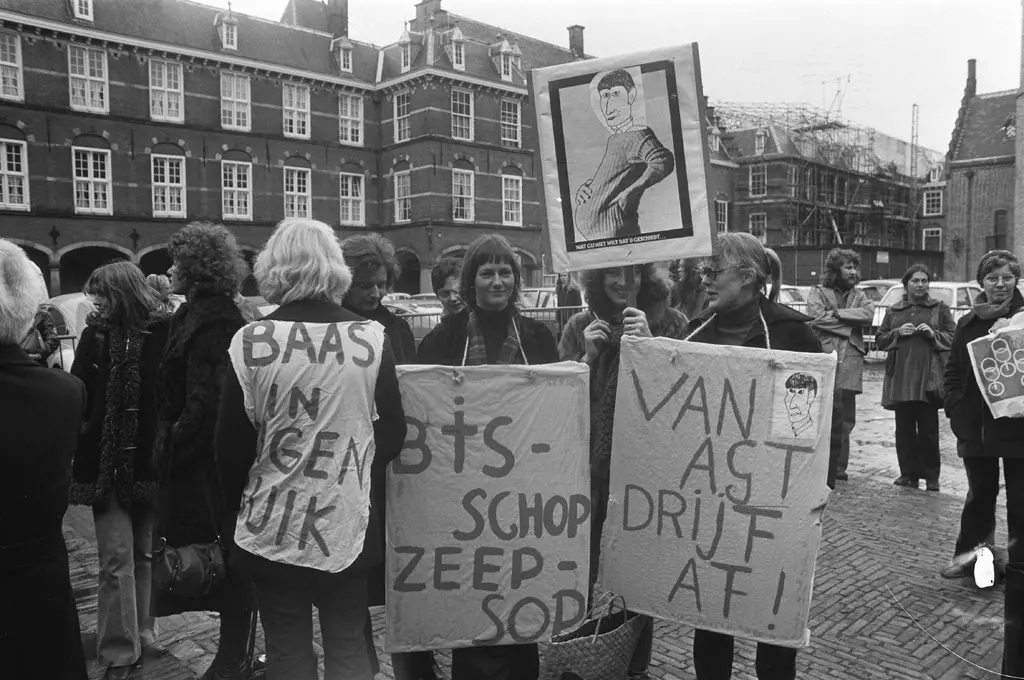
Supporters of legalisation mobilised to secure the future of abortion clinics. In October 1974, the Wij Vrouwen Eisen (WVE) committee was therefore set up by three Dolle Mina's of the first hour: Ria Sikkes, Selma Leydesdorff and Marjan Sax.
WVE had three demands for the legalisation of abortion: the woman decides, abortion from the Penal Code and abortion in the health insurance scheme.
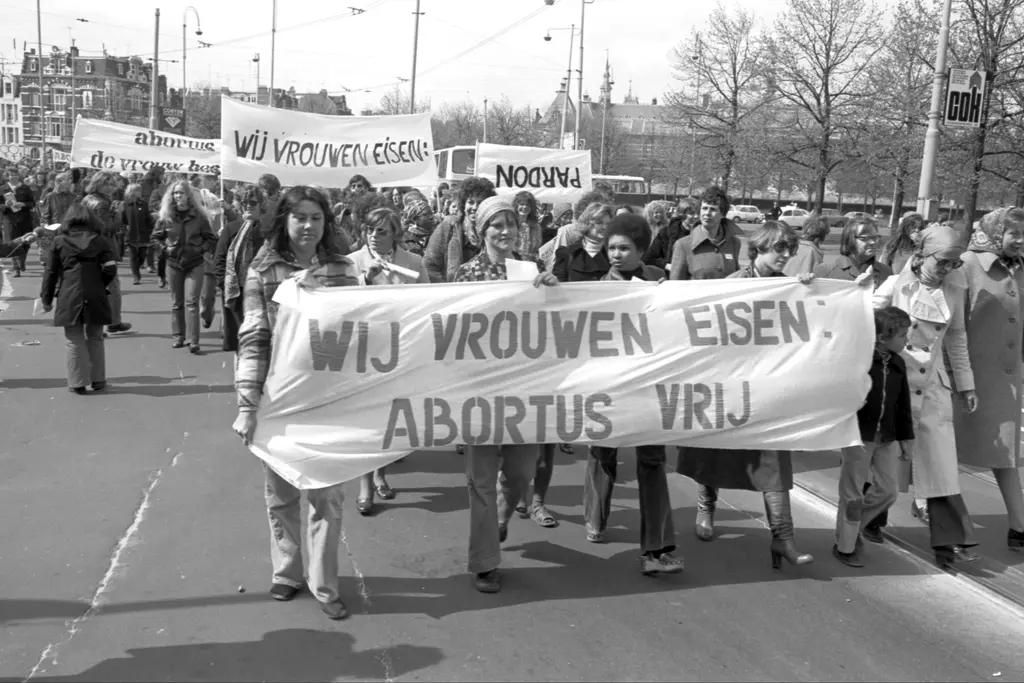
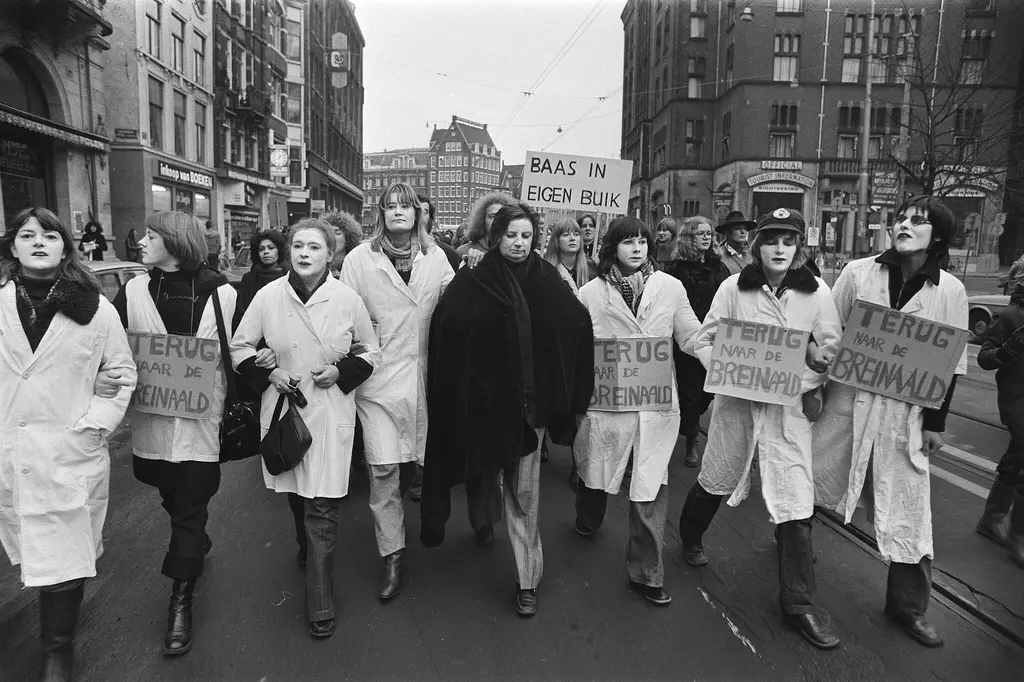
WVE was an action-oriented organisation, which went on to play an important role in the abortion struggle through its demonstrations, signature actions and card actions, among others. The first demonstration took place on 14 December 1974. Soon after, many organisations joined or expressed their support, including MVM, Dolle Mina, all left-wing political parties, the COC and the NVSH. Individual women could also become members. Local committees were set up throughout the Netherlands. WVE would organise several more mass demonstrations, such as those on 24 April 1976, 10 September 1977, 2 February 1980 and 27 September 1980 in Amsterdam.
In addition to these more large-scale actions, WVE was also committed to spreading information among women on a smaller scale. An important motto was that WVE did not necessarily fight for abortion, but for a woman's freedom of choice to have a medically responsible, legal abortion, should she face an unwanted pregnancy. Therefore, WVE also frequently campaigned to inform women about abortion and other forms of birth control. With proper education, WVE hoped to prevent as many abortions as possible.
Providing information about abortion and the abortion struggle took place in various ways. For instance, women were kept informed through magazines such as the abortion newspaper and the Dolle Minablad. Women were also informed about abortion and contraception through information sessions and discussion evenings. This included, for example, Hillie Molenaar's documentaries. The films Abortion is not something you do just like that and Abortion, from knitting needle to political joust were shown at WVE meetings. Thus, providing information could work both ways. On the one hand, to influence social and political debate. On the other hand, to create more awareness among women and men who might have to deal with abortion.
In 2020, members of We Women Demand and Atria launched five filmed interviews on the action committee's abortion struggle. The films are an addition to the archive of We Women Demand that can be accessed at Atria.
1976: Occupation of Bloemenhove clinic
In 1976, a German patient filed a complaint about careless treatment at the Bloemenhove clinic. This became the starting point of one of the most famous actions of the abortion struggle. Minister Van Agt saw his chance to achieve what he had failed to do in 1974: close the abortion clinic.
In doing so, however, he had not counted on the women's movement, which took immediate action when the public prosecutor tried to seal the treatment rooms. The director of Bloemenhove alerted some women from the women's movement, who immediately jumped in the car. They made sure the treatment rooms could not be sealed. Through a telephone snowball, a group of more than two hundred women was then rounded up within a short time. They occupied the clinic in shifts for more than two weeks, until the danger had passed. Meanwhile, treatments could continue as usual. The action generated national media attention.
1978: International Contraception, Abortion and Sterilisation Campaign
The actions of Dutch abortion activists were not limited to the Netherlands. On 10 June 1978, a group of 25 women from the Netherlands, France, England, Belgium, Spain, the United States, Switzerland, Italy and Colombia met in London with a special purpose: to establish the International Contraception, Abortion and Sterilisation Campaign (ICASC). This stemmed from an earlier European initiative coordinated from London. They wanted to promote access to legal and safe abortion, contraception and sterilisation.
Their first major activity was the International Day of Action on 31 March 1979. The button below from the Atria archive was designed for this purpose. In 1980, We Women Demand also joined ICASC.
From the 1970s: Black, migrant and refugee women on abortion and self-determination
Members of Dolle Mina and WVE were predominantly white and middle-class. This makes black, migrant and refugee women less visible in the large-scale abortion struggle. Timing also plays a role here. The struggle for abortion rights had already been largely taken up by MVM, Dolle Mina and WVE before most of the large groups of black, migrant and refugee women came to the Netherlands. From the 1970s onwards, however, these black, migrant and refugee women also increasingly set up their own organisations and networks en masse to promote interests specific to them. Women from all kinds of backgrounds came together to work on their gender equality and to make their voices heard. In what ways were they committed to self-determination, and how did abortion fit into their gender equality struggle?
The great diversity within the black, migrant and refugee movement is reflected by the wide variety of issues that different black, migrant and refugee women (organisations) dealt with. For instance, racism and the many prejudices in the Netherlands were naturally important overarching topics. There was also a focus on problems such as: discrimination on the labour market, domestic violence, no independent residence permits for migrant women, and lack of access to social services in the Netherlands. There was a need to work towards both the personal and social gender equality of black, migrant and refugee women. Several facets of self-determination were important in this. Besides disposition of one's own body, economic independence, for instance, was also given priority.
To work towards the gender equality of black, migrant and refugee women, information provision was mostly used. Through information sessions, discussion evenings and conferences, black, migrant and refugee women were taught and acquired skills. In addition, many black, migrant and refugee women's organisations had their own magazines through which they put out information. This enabled women to obtain the information needed to navigate in the Netherlands. Information was also disseminated externally in this way precisely to inform Dutch society about the position of black, migrant and refugee women.
Within information dissemination through information sessions and magazines, there was also the opportunity to cover topics such as abortion and other forms of birth control. This was done explicitly, but mostly these topics also seem to be embedded in larger themes such as sex education and health (care). Less focus was on the fight for legal abortion and more attention was given to the practical information around abortion, such as how it takes place. Information provision was also used as a way to break taboos around sexuality. Certainly the feminist Surinamese magazine Ashanti set itself the explicit goal of breaking taboos around sexuality. For instance, Ashanti published informative pieces on abortion, contraception, menstruation, and masturbation. However, the many discussions on sexual issues often drew criticism from the writers. Both from men from the Surinamese community and readers of the magazine.
Providing information on abortion and birth control took many other different forms for black, migrant and refugee women. For instance, there were thematic meetings on feminism and self-determination organised by the National Organisation of Surinamese Women, where abortion and the role of disposition over one's own body and sexuality were also discussed. There were also general health information sessions by the Moroccan Women's Association of the Netherlands, El Samra and the Turkish organisation HTKB (Hollanda Türkiye Kadinlar Birligi), where birth control was among the topics discussed. In addition, forming a network also helped women to be able to support each other on a one-to-one basis. This way, they could help each other find the right address in a more approachable way when there was an unwanted or unplanned pregnancy.
So although the subject of abortion was written and talked about in various ways within black, migrant and refugee women's organisations, this was certainly not an option for all women. Indeed, there were great taboos on topics such as abortion, birth control and sexuality. These were topics that were simply not talked about; especially not with outsiders.
Apart from the provision of information around birth control and despite taboos and other pressing issues for black, migrant and refugee women (organisations), there are nevertheless a few examples, where ZMV women openly expressed being in favour of abortion rights. The left-wing, Turkish women's organisation HTKB (Dutch Turkish Women's Union) supported Wij Vrouwen Eisen and marched in the 1980 demonstration. Thus, a photo in the Turkish Women's Newspaper shows Turkish women walking with a banner reading "We Turkish Women Demand". According to Mathilda Blank, Stichting Belangenbehartiging Surinaamse Vrouwen also supported WVE's demands. In addition, a call to attend this demonstration could be found in Ashanti magazine. This magazine further made it clear that it was in favour of women's right to self-determination and supported later actions by WVE to keep contraception in the health insurance package.
Other groups or organisations of black and migrant women do not seem to have similarly engaged in this large-scale struggle for abortion rights. However, several, individual black, migrant and refugee women were active in the abortion struggle. For example, by getting involved within an organisation like WVE or by attending abortion demonstrations. Like, for example, Gharietje Choenni, who participated in demonstrations by Dolle Mina, Tineke E. Jansen who participated in actions by WVE for years or Natascha Emanuels who performed with the Women's Cabaret at abortion demonstrations.
1980: Bill passed in House of Representatives
After the first bill by Lamberts and Roethof in 1970, three more initiative bills for abortion legislation were rejected during the 1970s. One of these, a collaboration of the PvdA and VVD, did pass with a large majority in the Lower House. But rejected in the Senate.
The bill that was finally passed by the Lower House on 18 December 1980, and later by the Senate, came from VVD minister Leendert Ginjaar and CDA minister Job de Ruiter. It was a compromise: abortion remained in the Penal Code, but would not be prosecuted if it took place in a licensed clinic or hospital. The woman would not have to give a reason for the abortion. However, a mandatory five-day reflection period was introduced and women always had to consult with a doctor first, which was also widely criticised at the time: both from politicians and civil society organisations. We Women Demand organised demonstrations in Amsterdam against the bill on 2 February and 27 September 1980. They wanted women to be able to decide on abortion themselves and for abortion to be removed from the Penal Code.
The bill was narrowly passed in the House of Representatives. There were 76 votes in favour and 74 against. Those voting against the bill included Labour Party, D66 and SGP.
1981: Women's strike against abortion law
Throughout the Netherlands, women laid down their paid and unpaid work en masse on 30 March 1981. In doing so, they demonstrated against several issues, but especially against the abortion bill that was to be debated in the Senate the following day. Many women were dissatisfied with the law: they wanted to be able to make full decisions about their bodies.
Hundreds of thousands of women took part in the strike, including staff of the International Archive for the Women's Movement (IAV), now Atria. Women on strike hung a sheet from the window, and many also took to the streets.
1981: Bill passed in Senate
The Upper House also narrowly passed the Ginjaar/De Ruiter bill. By one vote (38 against 27), the new abortion bill was approved on 1 May 1981. The political parties were relieved that this protracted point of contention had been resolved just before the 26 May elections. The Netherlands finally had an abortion law, although it took another three years for it to come into force.
1984: Termination of Pregnancy Act (Wafz) introduced
1 November 1984 was the capstone of the years-long abortion battle in the Netherlands. That was the day the Termination of Pregnancy Act came into force. Abortion was still in the Penal Code, but now a pregnancy could be legally terminated up to 24 weeks in a special clinic or hospital. In the Netherlands Antilles, the old legislation remained in force. There, abortion remained illegal but was tolerated.
There was disagreement over reimbursement by the health insurance fund, but since 1985 abortion has been covered by insurance. This first came from the General Act on Exceptional Medical Expenses (AWBZ), which was replaced by the Long-Term Care Act in 2015. However, abortion is not reimbursed for everyone in the Netherlands. Only people living permanently and legally in the Netherlands are insurable. International students, refugees, undocumented women and non-working women whose partners have work visas are therefore excluded.
* By 'abortion' in this timeline, we refer to 'abortion provocatus', or the deliberate termination of a pregnancy.