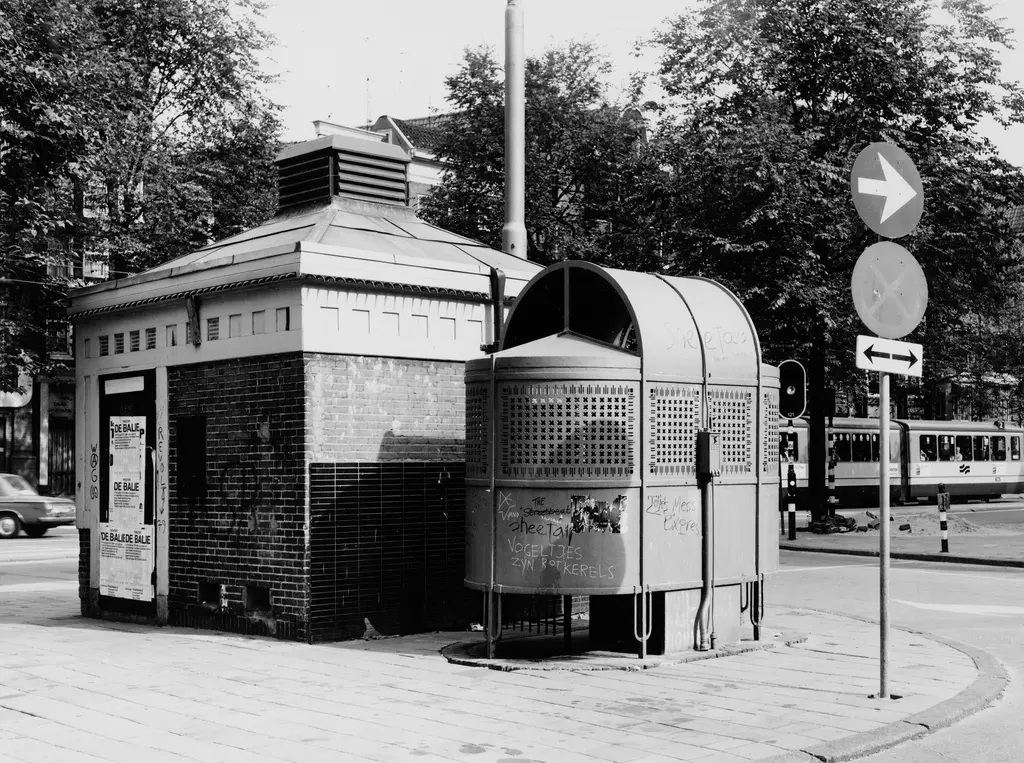
Desperately you wobble from one leg to the other. You have to and you need to! Now to find a public toilet you can use as a woman. You will never make it. Peeing outside the door is not a matter of course in the Netherlands. Our country has about five hundred public toilets that are accessible day and night. Moreover, most of these are urinals and therefore only suitable for men.
Desperately you wobble from one leg to the other. You have to and you need to! Now to find a public toilet you can use as a woman. You will never make it. Peeing outside the door is not a matter of course in the Netherlands. Our country has about five hundred public toilets that are accessible day and night. Moreover, most of these are urinals and therefore only suitable for men.
In the Netherlands, we are hopelessly behind countries like Spain, Portugal and France. In Paris alone, you will find 750 public toilets and almost every Spanish and Portuguese supermarket has a toilet at the entrance. Not being able to pee in public is annoying and restricts your freedom of movement. But besides the personal inconvenience, public toilets tell another story. About who owns the street, for instance. Or where we stand when it comes to gender equality. About peeing rights and urinating in public. And how the latter can cause a fine, but was also a spark for action, almost 50 years after Dolle Mina's High Distress Action in the 1970s. But more on that later. First, we dive a little deeper into both history and Atria's archives to find out more about public toilets and, in particular, public toilets for women in the Netherlands.
Curl for man who has his work on the street
We start in the nineteenth century - in 1847 to be precise - when Amsterdam got its first two public toilets. Urinals, for men only and without a proper flushing system. That must have stunk! Perhaps the reason men mainly urinated against the outside of the two little buildings. A new urinal design made that no longer possible. The first Amsterdam curule - designed by the Public Works Department - was installed in the 1970s. Intended 'for the man who has his work on the street', according to the urinal committee. On high legs and with holes, you could easily see from the outside whether the curl was occupied. Besides the single curl, there was also a double curl. The ability to urinate in public was starting to become something, at least for men. Because while there were some facilities for women in the city centre, it was out of all proportion to urinals for men. The higher cost and the fear of lewd acts in lockable toilets also played a role.
The Groenewegje
It would be another hundred years after the placement of Amsterdam's first curule before it would be 'occupied' by Dolle Mina to call attention to women's peeing rights. In the intervening century, things seemed quiet around the issue. Women had more than enough other things to worry about. During the 'first feminist wave' (1870-1920), women's organisations in particular fought for women's suffrage and access to (university) education and paid work. Remarkably, when, in 1918, Suze Groeneweg became the first woman in the Netherlands to be elected as a member of parliament, her entry into the Binnenhof (Inner Court) had quite some consequences. The Chamber building, like the public domain, was still completely geared to men. So were the toilets. A private toilet and bathroom were specially fitted out for Suze Groeneweg. The corridor where these came was also known as the 'Groenewegje'. This often led to mischievous jokes because at the time, a street with the same name ran through The Hague's red-light district.
Peeing on Valeriusplein numbers 7 and 8
In Amsterdam in 1922, Jan Meyer was commissioned by the municipality of Amsterdam to design two toilet houses, one for men and one for women. These were intended for Valeriusplein, a busy thoroughfare in Amsterdam-Zuid. A public toilet would bring relief to people 'passing through' and to visitors coming from far away for the Valerius Clinic on the east side of the square. The clinic therefore insisted on a facility. The two half toilet houses in the Amsterdam School style were Amsterdam's first modern underground toilets, number 7 was for men and number 8 for women. The houses are still there and have been restored to their original style after quite a bit of digging and repair work. You can even still go to the toilet there, at least if you get your hair done at the hairdresser's now located there. Then pay special attention to the original signs still hanging on either side of the little buildings, 'men' and 'women' in the distinctive Amsterdam School letters.
We demand public urination rights
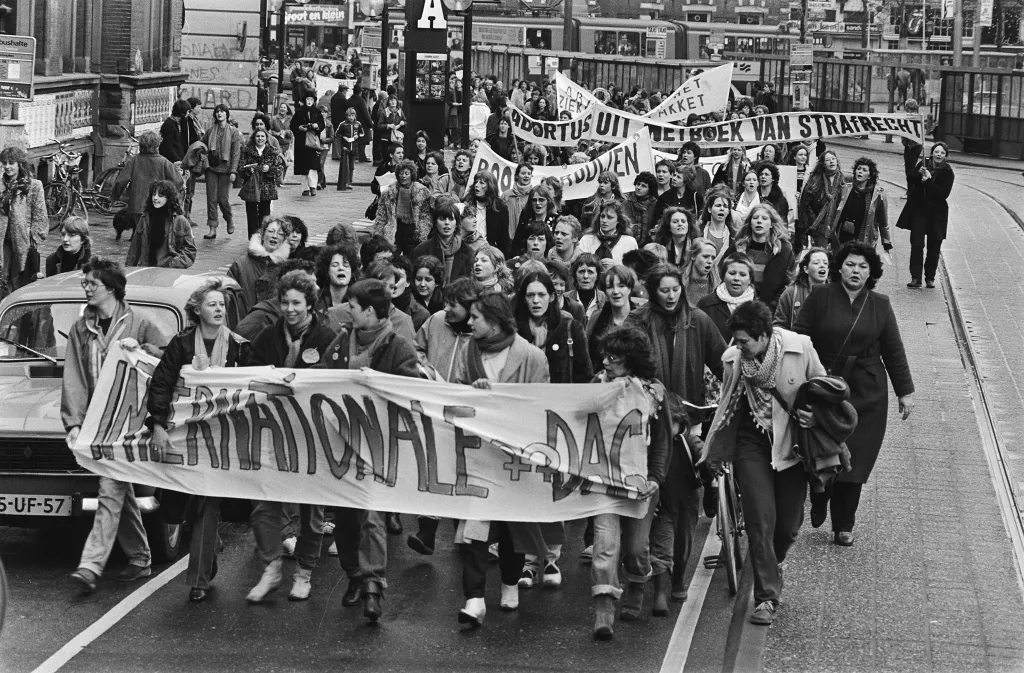
A'second feminist wave' emerged in the Netherlands in the late 1960s. Joke Smit's article Het onbehagen van de vrouw, published in 1967, is often cited as a starting point. In 1968, Man Vrouw Maatschappij (MVM) was founded, followed in December 1969 by the more radical Dolle Mina, which attracted a lot of attention with its playful actions. For instance, at the Amsterdam city hall, Dolle Mina's warned brides about the 'slave role' awaiting them as housewives, and they called for a cooking strike on television. On 24 January 1970 - 100 years after the installation of the first Amsterdam Curl - Dolle Mina demanded pee rights for women with the Aktie Hoge Nood. Amsterdam Curls were cordoned off with pink ribbons, toilet paper and banners. The Dolle Mina's handed out pamphlets and used the action to show that public space was mainly for men. After all, why were there public toilets for men and not for women? They were supposed to pee at home or rush to a pub in case of emergency. Or as Dolle Mina Nora Rozenbroek wrote in a pamphlet:
"Why can men get rid of their water in all the city's curls? Why can't women? Don't women need that? Or do women just have to 'do it' in a pub. (They are not even allowed in alone) Or do women have to climb up three flights of stairs at V&D? Then queue up and pay a dime too. Or do women not "have to" go into the city at all? Are women locked up at home anyway and the city is only for men?"
There you sit
In Atria's archive, you will find thirteen photos of the Action High Distress. Upon seeing them, you understand why the action received a lot of attention from passers-by and in the press. A drawing pasted on an Amsterdam curl shows a seated woman in a public men's toilet. Her bare buttocks peep under the rim and next to it is the text 'There you sit'. Yet the curl was not only meant for men, according to Amsterdam civil servant and member of the urinal committee I.B. Visser. In an interview with Vrij Nederland journalist Igor Cornelissen, he said of the Dolle Mina action:
"For women, of course, it is a matter of training: they should not squat, because then you see the buttocks."
Asked by Cornelissen whether women were fined when they wildfaced in the absence of a public toilet, he responded, "Being fined in such a case is very sporadic as far as I know. When I myself would be in such a situation and a cop would come to me, I would say: I had to choose between in my trousers or outside my trousers. I think the police are very tolerant on that point."
The Aktie Hoge Nood also inspired writer Salomon Cohen. In a poem - which you can find in Dolle Mina 's archive - he writes this stanza:
"men are allowed to pee for free
in such a beautiful stone building
but the woman has to spend money
who is always in dire straits"
Clogged toilet eyesore
Even outside the capital, Dolle Mina's peeing rights action penetrates the country. In October 1971, the Leeuwarder Courant carried a piece about a well-kept secret in Haren: a public toilet 'hidden in the basement of the public library'. Staff declare they have never seen anyone enter it. Not surprisingly, as there is no sign of the facility. Moreover, the toilet is for gentlemen only. 'Haren women in high need have not been taken into account. For them, this beautifully tiled and sink-equipped space does not meet any need. Here lies another rewarding task for the Haren Dolle Mina's.' (Leeuwarder Courant, 23-10-1971)
Peeing French style
Despite the attention given to 'Aktie Hoge Nood', there is little movement on facilities for women. However, in the years that follow, more and more urinals disappear, as the urinal committee believes there are now too many in Amsterdam's city centre. When the Sanisette for both men and women is installed in Paris in the 1980s, the committee is enthusiastic. Peeing for one franc with music playing in the background ánd a self-cleaning pot. Although the municipality entered into negotiations with the supplier, the toilets ultimately did not materialise. Too expensive.
Pee freedom with the urinal
Towards the end of the 20th century, Simone Zijp gave new impetus to women's 'pee freedom' in public. She developed the urinal in 1998, which is still sold today under the name P-Mate. Initially, the urinary spout was made of plaster or rubber and it was only from 2000 that the definitive cardboard spout was launched on the market. Zijp folded the plastuites by hand, helped by friends and family. The cardboard plast spout found eager demand. Trouw published an article in August 2000 with the headline Plastuit is sold out. In it, Zijp says that the product is well received by female visitors to the Torhout Werchter music festival (where she also introduces the plastuit in Belgium), but that she also sells the plastuit on the internet to elderly ladies in addition to 'young pop music lovers': 'They appear to be "beyond shame". These are mostly women who are members of a walking or cycling club who regularly have to pee when there is no toilet nearby. Or women who don't fancy the dirty toilets along the motorway on the way.'
Women's urinal without feminist motif
Almost at the same time as the urinal, a urinal for women is marketed (1999) under the name Lady P. Industrial designer Marian Loth had designed the model as a graduation project at TU Delft a year earlier with accompanying partition. She got the idea for this during a visit to the North Sea Jazz Festival. The friend Loth was with - in despair over the long queue for the women's toilet - used the men's urinal. That went surprisingly well, Loth says in an interview on Delta, TU Delft's journalistic platform, so why was there no urinal for women? She delved into 'the psychological and social problems of urinal use with a survey of 47 women and enthused sanitaryware manufacturer Sphinx for her thesis project. Because most women 'hang out' over the toilet, this - along with six criteria around hygiene and acceptance - is the starting point for her design. Loth explains:
"Women don't want to touch the glasses, it's just deeply ingrained in them. As a precaution, they then hang above them."
But she also thinks the shape is important. Loth does not want it to resemble a men's urinal because, according to her, many women have negative associations with that. It ultimately resulted in a narrow and graceful model that is about the same as a men's urinal in terms of production costs. According to Loth, the investment will allow Sphinx to raise its profile among an important target group: women. Asked whether the ladies' urinal will also spearhead the women's movement, Loth says feminist motives really did not play a role in this project. And while she did always want to do something for the position of women, there was simply a problem here that she wanted to solve.
In cubicles
The lady urinal eventually ended up in a number of places in the Netherlands, including Schiphol Airport, a discotheque in Amsterdam and at the faculty where Loth graduated. But the lady P. did not become a success. "People didn't really understand what to do with it anyway. On top of that, my idea was not executed properly. I wanted to separate the urinals from each other with slanted partitions, to create some privacy. But the buyers went further than that and put the lady p's in cubicles. Part of the benefit then disappears," Loth said, looking back on the adventure in 2015. The Industrial Designer is still concerned with public toilets and how to improve hygiene and attractiveness for all, especially in trains. And that brings us back to Dolle Mina after all.
Still no urination rights
Exactly 43 years after Aktie Hoge Nood, Dolle Mina is again calling attention to pee rights. In a toiletless sprinter from Amsterdam to Almere, they install a homemade toilet stall made of banners they brought along and a po to do their need as well as to make their point again. Dunya Verwey and Claudette van Trikt, Dolle Mina's of the first hour, are there. "What makes us very angry is that there is still no right to urinate," Dunya told AT5's camera.
Action #pee
When Geerte Piening empties her full bladder in an alley near the Leidseplein in Amsterdam on the night of 22 May 2015, she has no idea that this will put the peeing battle back on the agenda. She receives a wild urination fine and contests it, saying she did not go pee in an alley for fun but because there was nowhere near a public toilet. Only two years later, the case comes to court, and Piening, who is conducting her own defence, ends up having to pay a fine of 90 euros after all. The magistrate advised Piening to do her needs on a urinal from now on, if necessary.
Impossible, according to Cathelijne Hornstra, who posts the Urinal Urination for Women action on Facebook as a response. She calls on women to take a photo at a urinal in their hometown on Saturday 23 September 2017 and share it with the hashtag zeikwijf to show that it is impossible to pee on a urinal as a woman. "Peeing in a men's urinal is not clean, not neat, unsafe and unworthy," the initiator said. Thousands of women agree with her, responding to her action on Facebook and signing the petition. Geerte Piening, meanwhile, is busy speaking to the media and in Amsterdam, the city council will adopt the initiative proposal 'Baas over eigen blaas' on 19 December 2018. This asks the college to start from the standard that there should be a public or open toilet within five hundred metres in the city centre and in busy pedestrian areas. Sounds good, in theory. But what does it deliver in practice? We jump ahead in time a few years.
Who does the street belong to?
In 2021, for its series The Lessons of Dolle Mina, Atria interviews young people on the streets about the Action High Emergency. Their statements sound like echoes from the last century: "as a woman in the city, you can't actually go to the toilet", "I'll keep it up then", "because I have no choice" and "the pee curl is really meant for men, because as a woman it is almost impossible to be able to use it".
So has so little changed?
The establishment of The Toilet Alliance in 2018 seems to be an answer to that question. The alliance is an initiative of the Maag Lever Darm Stichting and an alliance of more than 20 civil society organisations committed to more public and open accessible toilets. Their mission: "by 2025, the number of Dutch people who sometimes to regularly stay at home because of the lack of toilets will be halved (...) because there are enough toilets. The toilet alliance is fighting for an inclusive and accessible Netherlands with #everyewctelt ". With the HogeNood app, the alliance offers a practical solution by registering as many public or semi-public toilets as possible in the Netherlands. In the app, you can search throughout the Netherlands and filter toilets by male or female and whether the toilet is free, among other things. Would the Dolle Mina's find this app a godsend or would they first count how many women's toilets have now been registered?
Public toilets, from practical problem to personal problem to social problem. In any case, there is much to tell, discover and discuss.
Update 16 April 2024: After years of discussion, new public toilets are coming to Amsterdam