That the Nationale Tentoonstelling van Vrouwenarbeid (1898) (National Exhibition of Women's Labour) needed the help of artists was obvious. The promoters wanted to develop promotional materials for the exhibition. It was the first time they were doing such a thing and the organisers had to find a way in soliciting artists. Preferably female artists, as the exhibition was for and by women.
That the Nationale Tentoonstelling van Vrouwenarbeid (1898) (National Exhibition of Women's Labour) needed the help of artists was obvious. The promoters wanted to develop promotional materials for the exhibition. It was the first time they were doing such a thing and the organisers had to find a way in soliciting artists. Preferably female artists, as the exhibition was for and by women.
The aim of the Hague event was to positively influence public opinion towards women's labour and expand their employment opportunities. It is hard to imagine now, but it was then a radical action to challenge society to recognise labour by women. The organisatrices therefore packed in a lot of actions. One of the recruitment campaigns involved a lottery. The poster for this was created by the famous artist Jan Toorop. But why was the poster designed by a man and not a woman? Compared to the British struggle for women's suffrage and visual propaganda, which was often created by female illustrators there, it is striking that this was less the case with Dutch advertising for women's labour. (*)
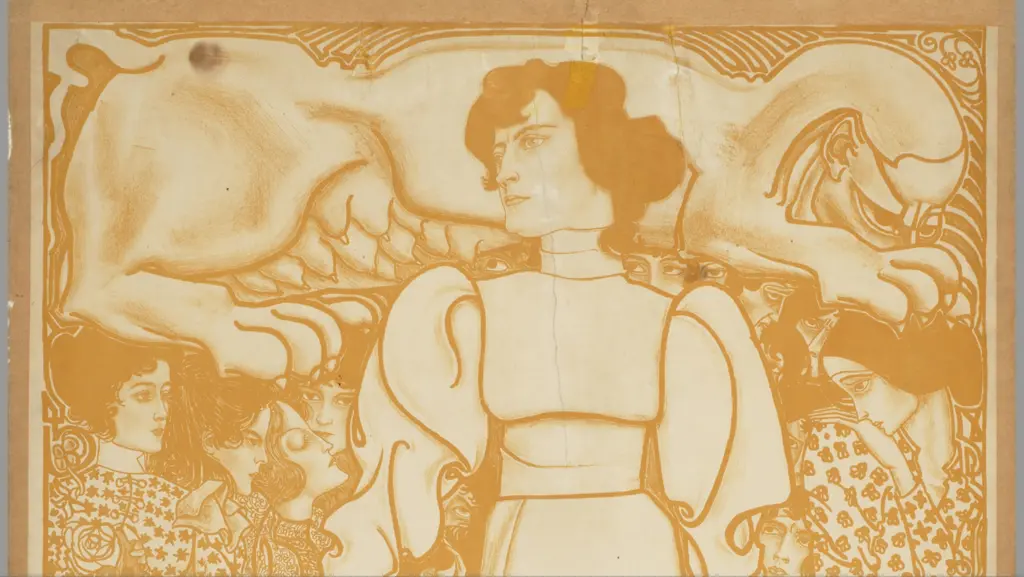
What does the poster depict?
The woman in the centre is prominent in the foreground; the female figures on the sides are drawn smaller. Some look dejected and a fearsome female sphinx towers above them. What did Toorop want to express with this?
The central figure is the most interesting. Toorop had already drawn this woman's portrait in 1897. He later applied this to the lottery poster. He probably drew the body with the dress, as fashionable at the time and worn by bourgeois women, separately. The female figures on the sides represent the workers. In 1898, they were still on the underprivileged side of society.
The organisers of the Exhibition were themselves mainly from the well-to-do middle class and focused the exhibition primarily on this group. From working-class women, they expected no interest. After fierce criticism from socialist women such as Henriette Roland Holst, they adjusted their objective. Still, the incorporation of workers remained difficult. For instance, the admission price of the exhibition was too high. Toorop had seen this correctly. He wanted to portray the disadvantaged position of workers. In fact, his artwork was critical of the organisation.
The figure of the sphinx confirms this theory. According to Toorop, this figure represented "the symbol of the mystery of life. Those, who are entirely under the claws of the Sphinx, are the beings of lower order". The claws of the sphinx on the poster grasp the heads of this lower order, the workers.
How did the order for the poster reach Jan Toorop?
It is possible that Toorop obtained the order through his network in The Hague and came about verbally. He granted his contribution selflessly. This fact and the way he related to women in his artworks speaks for his support. He saw women as the symbol of social change.
However, the organisers did try to recruit women artists. This is shown by the letters from the visual arts academies, preserved in Atria's archives. The schools responded to a call if girls wanted to participate in decorating the exhibition. Of the 14 authorities contacted, only one agreed to participate. The others informed that their education did not allow their students to participate or that there were no or too few female students in their institutions at all. This is a good explanation why male artists worked for Nationale Tentoonstelling van Vrouwenarbeid. Not enough women had been trained in the applied arts in 1898.
And after that?
Fifteen years later, the women's movement re-entered the public eye with a major event, namely the Tentoonstelling De Vrouw 1813-1913 (Exhibition The Woman 1813-1913). The visual representation of the working class was then designed differently and class distinctions less prominent. However, more women did participate in the designs for the promotional products in 1913. Meanwhile, new industrial schools had been established in the Netherlands with room for girls.
(*) In my unpublished essay The Woman, the Sphinx and Applied Art in 1898: Analysis of Jan Toorop's lottery poster 'Labour for Women', I noted that Suze Fokker had designed the general advertising poster for the NVTA, but "it had not received much attention", according to M. Altena, Visual Strategies. Photographs and films of factory workers in the Netherlands 1890-1919, chapter 5 'Showing the uninhabitable. Photography and film in the women's movement, p. 226.