For the past six months, Marsha Keja, project officer for inventory, at Atria, has been inventorying the 13-metre(!) long archive of journalist and resistance woman Elka Schrijver.
For the past six months, Marsha Keja, project officer for inventory, at Atria, has been inventorying the 13-metre(!) long archive of journalist and resistance woman Elka Schrijver.
Elka Schrijver has left both her archive and a financial donation to Atria through her will. A very special way to contribute to the survival of the archive. I interview Marsha about exactly who Elka Schrijver was and how the inventory process works.
Who exactly was Elka Schrijver and why is it interesting to have her archive at Atria?
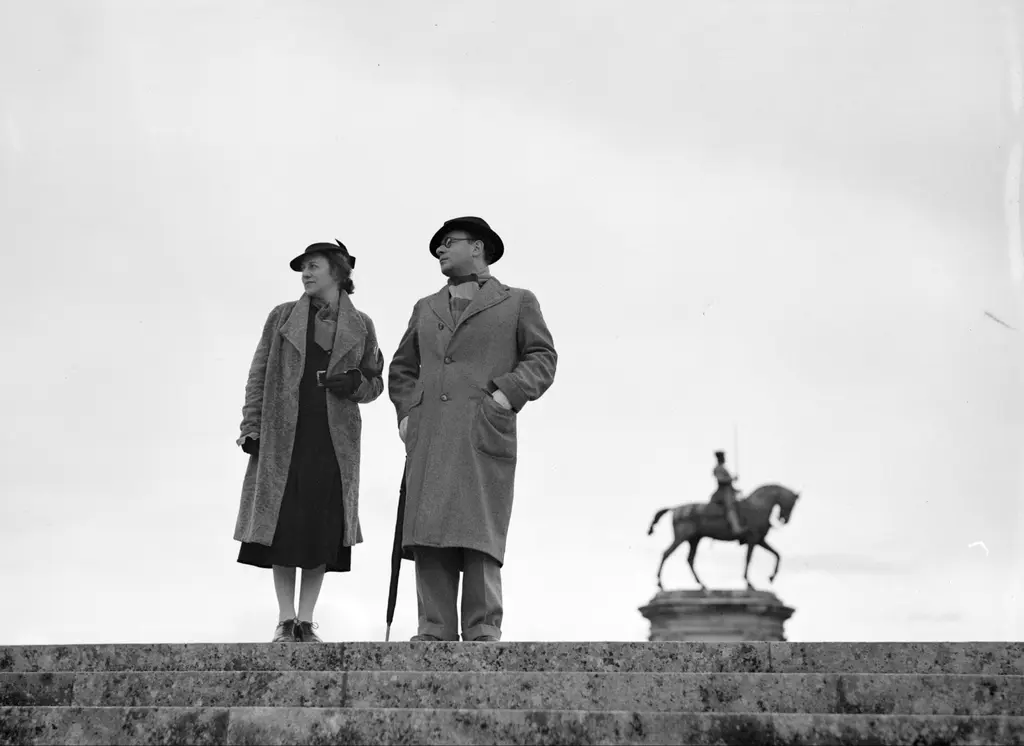
Elka Schrijver was born on 30 October 1899 and died on 27 August 1989. She lived and wrote about almost the entire 20th century, covering all the developments that took place in this century. That alone makes it an incredibly interesting archive.
Schrijver grew up in a liberal Jewish milieu and after the girls' H.B.S. she also graduated from the mixed H.B.S. with which she went on to study horticulture in Wageningen. After moving to England in 1921, she trained as a copy-writer and worked for leading advertising agencies. In 1931, she went to work for Rotterdam publisher Nijgh & Van Ditmar. In 1935, she established herself as a freelance journalist and actually remained so all her life, almost until her death.
As a freelance journalist and copywriter, she worked for the advertising agency of Tom (A.A.) Bosschart who led an anti-fascist and anti-communist group, which Schrijver joined from 1939. For this, she did counter-espionage work and produced and distributed illegal magazines. In March 1941, the group was betrayed and arrested. Schrijver spent time in various German women's detention centres until 6 May 1945 (after this she was liberated by the Russians).
After the war, she picked up her work as a freelance journalist again and worked for many different magazines until the 1980s. She wrote about fashion, art, history and social issues. She was also active for several women's organisations, and a member of several women's associations and the VVD.
The fact that Elka Schrijver freelanced and was active in various women's associations shows that Schrijver was an incredibly independent and self-reliant woman. She campaigned widely for women's rights and wrote about other independent women herself (see below). Schrijver was from before the generation of playful actions, such as the Dolle Mina action group. Nor was she at all leftist and progressive. Schrijver fought for women's rights more in a practical way, for instance by drawing attention to other emancipated women.
What does Schrijver's archive tell us about the role of women in World War II?
Schrijver was arrested and imprisoned as early as 1941. Her personal experiences of World War II are therefore mainly set in the women's penitentiaries in Germany. In contrast, she describes this in detail, so from her archive we can learn a lot about how women fared in these prisons.
But she did write about her experiences as a woman trying to join a resistance group. Tom (A.A.) Bosschart, whom she met at an advertising agency and who was also the leader of an anti-fascist and anti-communist group that Schrijver wanted to join, felt that as a woman she could not play a role in the resistance. It would be too dangerous for her. After long insistence, she was eventually allowed to join and was assigned to spying. As a woman, this work suited her because she did not stand out and no one would expect her to be in the resistance. So this also says a lot about the position of women in society at that time.
What else can we learn about Schrijver's archive?
Through her work as a journalist and writer, Elka Schrijver was well informed about national and international current affairs. She was incredibly broadly interested, as a result of which she gathered a lot of knowledge in numerous fields. Therefore, her archive is also interesting for research in several areas. She wrote a lot about her experiences during the war and about other independent women, which is of course very valuable for Atria.
But besides being a freelance journalist, she was also a translator. In the field of literature, therefore, a lot of information can be found in her archive. In addition, she wrote a lot about art. She wrote books on glass, crystal, silver, porcelain and she wrote for leading British newspapers about exhibitions in the Netherlands. Her archive also contains a lot of correspondence with specialists. People who may not be familiar with Atria can therefore turn to her archive if they are researching these kinds of art-related topics.
Elka Schrijver's archive may not be opened until 50 years after her death. That means we now have to wait another 18 years before it can be viewed. Now, unfortunately, we have to make do with just the inventory list, which describes all the documents in her archive. But if you take a look at that alone, you will see that it is also already full of interesting correspondences and links to organisations that we can already learn a lot from. And of course, the archive remains historically interesting for researchers when it is allowed to be viewed after 18 years. That is why we think it is so important to preserve this heritage at Atria.
How exactly does the inventory process work?
Elka Schrijver's archive was donated to Atria by herself. In her will, she mentioned that her archive is important to give a time picture of how the first generation of working women lived and worked as equal citizens. She therefore provided funds to open up the archive in addition to donating her archive. So actually I was paid by Ms Schrijver herself! Opening up an archive is very costly. Because Ms Schrijver also donated a sum of money through the Aletta Jacobs Fund, she directly contributed to managing and preserving her own archive. This is a very welcome addition to the grant Atria receives. In doing so, she has contributed to keeping the women's movement alive for future generations. A very special legacy indeed.
When inventorying an archive, you actually make sure that the archive is made accessible to researchers and that researchers can easily use it. This means that you have to organise the archive by subject and that things that belong together actually stay together, otherwise the meaning might be lost. In doing so, the arrangement that Elka Schrijver herself made is respected. And although I am therefore not the researcher myself, I had to find out what some documents were about or where they belonged. This way, you end up getting a very good picture of the archive and Elka Schrijver's work. It is actually a kind of puzzle!
What do you personally find the most interesting pieces from Elka Schrijver's archive and why?
Schrijver's archive is very personal. By researching and listing all the pieces, you slowly get a picture of her as a person, as if she came to life. One archive piece that really evoked historical sensations in myself, where I really felt like I was holding a tangible object from the past, was a leather folder of hers. This looked like a kind of large wallet in which she kept not only all kinds of documents and letters but also photos, membership cards and dings from still from the war. It looked like a folder she always carried with her.
"Another archive document that moved me a lot was her parents' farewell letter to her and her brother. Her parents left 'voluntarily' for camp Vught and were transported via Westerbork to Sobibor, where they were gassed immediately upon arrival on 14 May 1943. The farewell letter was therefore very moving to read."
Why is the archive important to Atria?
Not only Schrijver's archive, but also archives of other historical women are important to preserve because it contributes to mapping the heritage of women's history. Everything that is added adds to the archive that is already there. For instance, Atria also manages the archive of the Union of Women Volunteers, in which Schrijver was also active. So her archive is another addition to the UVV archive. In addition, her archive also includes other women who have archives at Atria, such as the archives of Willemijn Posthumus-van der Goot and Jane de Iongh. In this way, we see the network growing and we learn more and more about the women who lived before us and how they worked to improve the position of women and women's rights.
A few examples of articles Elka Schrijver wrote about women for the Algemeen Handelsblad between 1954 and 1957:
28-1-1954: Mevrouw M.C.W. Rohling-van Spanje. Een van de twee vrouwen in de Sociaal-Economische Raad
24-3-1955: Voortgezet gesprek met Staatssecretaris dr Anne de Waal
23-4-1955: Dr Jane de Iongh. Nederlands culturele attaché te Londen
20-10-1955: Beryl Miles, de vrouw van het grote avontuur
17-5-1957: Mejuffrouw ir. A.E.M. Bosch. Een vrouwelijke directeur in de Keuringsdienst van Waren