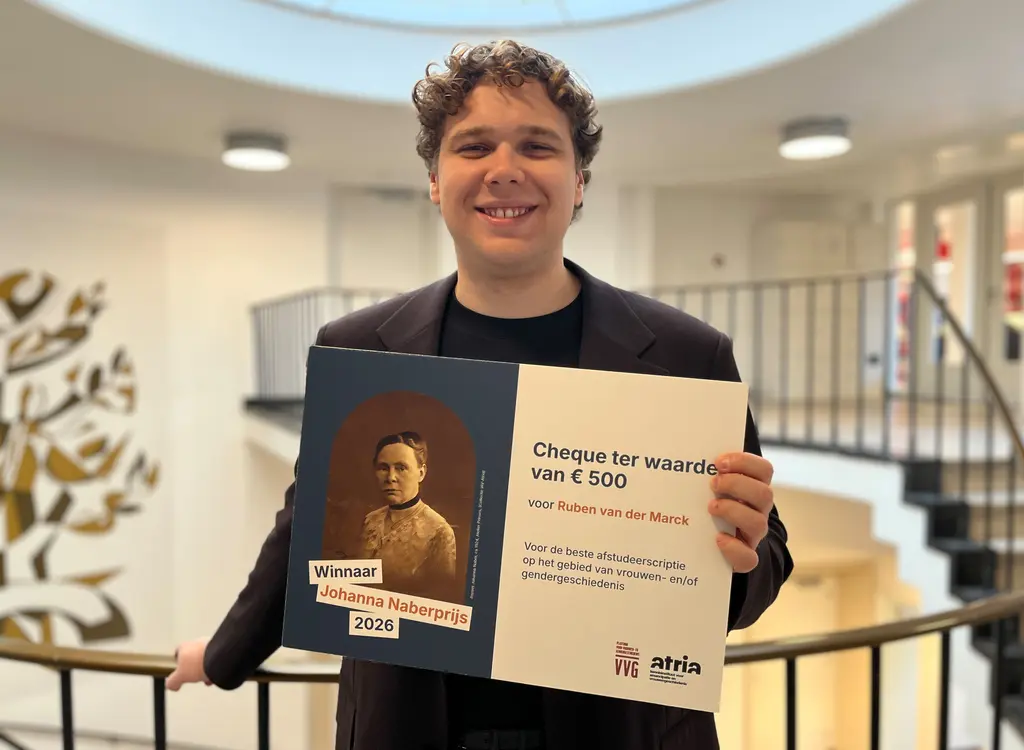
Ruben van der Marck has won the 2026 Johanna Naber Prize, the award for the best final-year dissertation in the field of women’s and/or gender history at Dutch and Flemish universities. His thesis focuses on the daily life of his great-grandmother’s European family in the former Dutch East Indies during the 1930s. Ruben van der Marck wins a prize of 500 euros and is given the opportunity to write an article for the journal Historica.
Ruben van der Marck has won the 2026 Johanna Naber Prize, the award for the best final-year dissertation in the field of women’s and/or gender history at Dutch and Flemish universities. His thesis focuses on the daily life of his great-grandmother’s European family in the former Dutch East Indies during the 1930s. Ruben van der Marck wins a prize of 500 euros and is given the opportunity to write an article for the journal Historica.
The Johanna Naber Prize was awarded on Gender History Day on 7 November 2026 by Atria and the VVG Platform for Women’s and Gender History.
Van der Marck, who wrote his Master’s thesis, A Life Under Judgement. Status, Prestige and Distinction in the Daily Life of a Colonial Family in the Dutch East Indies (1934–1936) at the University of Amsterdam, based his research on personal letters from his great-grandmother Guillaumine Eugénie Pierrette le Cocq d’Armandville (1904–2002). Between 1934 and 1936, she wrote to her parents in Europe about her life in the former Dutch East Indies.
The letters offer a unique insight into the daily life of a colonial household. Van der Marck demonstrates how social standing and racial distinctions were not only upheld outside the family, but also took shape within the household. The upbringing of children, language use, academic performance, friendships and ideas about health and physicality all contributed to the transmission of colonial norms and hierarchies.
The jury was impressed in every respect: the choice of subject, the use of the letters as a primary source, and the skilful analysis.
"One of the book’s great strengths lies in its demonstration of the crucial role played by Dutch women in maintaining and perpetuating colonial power structures in everyday life and at an individual level, including in child-rearing; it also highlights the extent to which the disciplining of children in a family such as this was shaped by colonial factors."
Personal letters as a historical source
What makes this research distinctive is the way in which Van der Marck approaches the letters. They are not only a reflection of everyday life, but also reveal how social relationships were actively affirmed and reproduced.
The researcher’s personal involvement also adds an extra dimension to the research: Van der Marck is himself a relative of the woman who wrote the letters. As such, his research touches on a broader question: how do you critically investigate a family history in which you yourself are involved?
With this study, Van der Marck makes a contribution to the historiography of colonialism, femininity and upbringing. At the same time, the research invites reflection on the lingering effects of colonial customs and social relations in the present day.
"We also believe that the use of the letter as an influential tool in identifying and reproducing the colonial hierarchy may inspire other historians, and we regard this as an important methodological step forward."
Jury
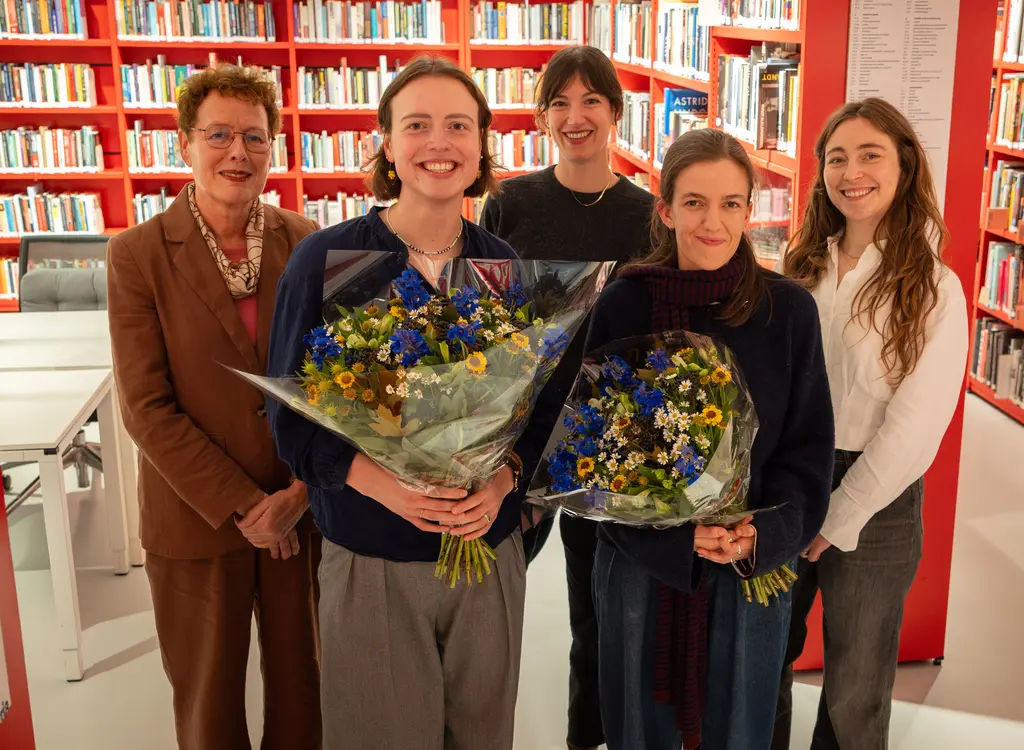
This year’s jury for the Johanna Naber Prize (JNP) consisted of: jury chair Francisca de Haan, Professor Emerita in Gender Studies and History at Central European University, a fellow at the International Institute of Social History and an affiliated researcher at Atria; Nel de Mûelenaere, Professor of Contemporary History at the Vrije Universiteit Brussel; Maite Karssenberg, writer and historian, winner of the 2026 Libris History Prize and winner of the 2016 Johanna Naber Prize; Marlies Couch, winner of the 2025 Johanna Naber Prize.