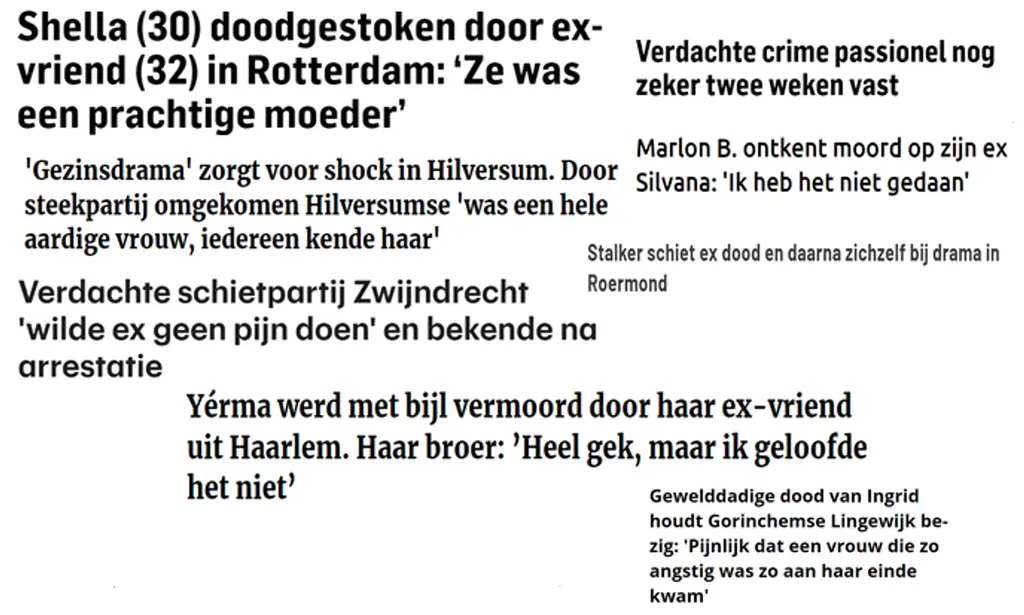
Femicide is a term that has very little familiarity in the Netherlands. It hardly appears in reports of the murder of a woman. This is damaging. Thus, we do not sufficiently map the violent pattern of this problem. How do we ensure that femicide does not fade into the background? An analysis of dozens of news stories from a range of Dutch newspapers (2017 - 2022) shows: reporting on femicide needs to improve.
Femicide is a term that has very little familiarity in the Netherlands. It hardly appears in reports of the murder of a woman. This is damaging. Thus, we do not sufficiently map the violent pattern of this problem. How do we ensure that femicide does not fade into the background? An analysis of dozens of news stories from a range of Dutch newspapers (2017 - 2022) shows: reporting on femicide needs to improve.
The absence of the term
Despite the fact that more has been written about femicide as a phenomenon in recent years, the term is hardly used in news reports, if at all. Articles refer to 'partner killing', 'family drama' or a 'crime of passion'. So although femicide cases are reported, these cases are not given the same designation. In other words, media in the Netherlands do write about femicide, but only as separate incidents and using different terms.
Neutral language in the media, not 'femicide'
Possibly the 'activist undertone' of the word femicide does not fit the neutral tone that characterises the Dutch media landscape. Indeed, that particular journalistic climate protects suspects from public opinion by withholding personal information. Journalists will therefore not share information that compromises the anonymity of the perpetrator. This is at odds with the desire of many journalists to protect suspects. It is a possible explanation for the absence of the term 'femicide' in most media. And thus the choice of more neutral descriptions like 'partner killing', or the even broader 'family tragedy' or 'family drama'.
Some news reports sometimes do not even mention who the perpetrator and who the victim is. The reporting is also gender-neutral. In this way, the reader does not find out which person killed whom, thus masking - and continuing to mask - the underlying pattern of a - predominantly - male perpetrator and female victim.
Unusual murder cases
Many reports in Dutch newspapers reflect this common invisibility of the victim. Typically, they are concise and focus on the criminal proceedings, without giving much detail about the circumstances or the relationship between the perpetrator and the victim. It often makes news reports on female murder very matter-of-fact, detached and concise. The victim often remains invisible. Yet murder cases that are 'unusual' are covered more widely than 'normal' murder cases. Think of an unusual method of killing or the fact that a manhunt was needed in tracking down a suspect.
Selling news
Commercially, the success of any newspaper depends on its ability to keep readers' eyes on the paper. So when a murder features macabre or surprising details, as in the manhunt example below, journalists will capitalise on it. In this way, they ensure that more people watch the news articles. Here, however, unusual elements often get more attention than the crime itself. Each murder case thus appears unique, leaving the broader pattern of femicide invisible.
'Ideal victim'
Newsworthiness plays a major role in how femicide comes to light, or rather remains invisible. In some articles, for instance, there is room for details and background information about the perpetrator and victim. Those reports are often about victims who fit the image of an ideal victim. That is, victims whom society labels as legitimate and who therefore gain more sympathy from the public. For example, the elderly, women or children: they are more often associated with innocence and thus more likely to be seen as legitimate victims. The 'ideal victim' also exhibits socially desirable traits of 'femininity', such as caring, motherliness and gentleness. News articles often highlight these traits, describing the female victim as a 'sweet teacher', 'loving mother' or 'caring grandmother'. Highlighting these stereotypical female characteristics of victims can reinforce their vulnerability and thus their innocence.
'We don't know him like that'
When articles give more information about the perpetrator, it is notable that they often mention mental illness as the reason for the act of murder. Those articles are supported by quotes from, for example, local residents or acquaintances: 'He must have gone mad' or 'We don't know him like that'. This can give readers the idea that the perpetrator is less or not responsible for the act - after all, he was suffering from mental illness, or 'he wasn't himself'. The case then appears to be 'an incidental accident'. The broader pattern then again remains invisible.
Media show worst cases, not pattern femicide
Attributing characteristics to a perpetrator or victim makes coverage personal. It ensures that femicide stories may come to light more often in the media and people continue to remember these stories. However, these 'unique' stories can also ensure that the underlying pattern of femicide remains invisible. Indeed, murders with victims that are less in line with these characteristics disappear into the background as a result. We should therefore ask ourselves whether it is desirable to name characteristics of specific individuals in a news article. After all, every case of femicide is equally bad. It may also ensure that by singling out certain cases and highlighting stereotypical characteristics, it may seem that some victims 'deserve' their fate more than others who do not fit the characteristics of the ideal victim. This does not make their case any less important or noteworthy, yet it unfortunately has the effect of doing so.
Make femicide visible in the media
What we need to find is a middle ground between paying enough attention to the victims and making news stories 'appealing'. Do not highlight only the unique cases extensively and be careful to accentuate stereotypes. Flattering terms, such as 'family drama' or 'altercation in the relational sphere' underemphasise the pattern of violence that precedes femicide. By actively using the term 'femicide', we make the problem visible in the media.
Source articles cover photo femicide in media:
'Shella (30) stabbed to death by ex-boyfriend (32) in Rotterdam: 'She was a wonderful mother'." Source: Provinciale Zeeuwse Krant, 19-01-2022.
'Family tragedy causes shock in Hilversum. Hilversum woman killed by stabbing 'was a very nice woman, everyone knew her.'" Source: Noordhollands Dagblad, 16-05-2022.
'Suspect stabbing Zwijndrecht 'didn't want to hurt ex' and confessed after arrest.' Source: RTL News, 27-02-2023.
'Yèrma was murdered with axe by her ex-boyfriend from Haarlem. Her brother: 'Very crazy, but I didn't believe it.'" Source: Noordhollands Dagblad, 13-02-2023.
Violent death of Ingrid keeps Gorinchem Lingewijk busy: 'Painful that a woman who was so anxious came to her end like this.' Source: Rijnmond, 19-09-2022.
'Suspect crime of passion detained for at least two more weeks.' Source: Het Algemeen Dagblad, 27-09-2012.
Marlon B. denies murder of his ex Silvana: 'I didn't do it.'" Source: Omroep Brabant, 03-03-2023.
'Stalker shoots ex and then himself in drama in Roermond.' Source: Hart van Nederland, 04-08-2022.