Gender-based violence is a serious social problem. In the Netherlands, 41% of women have experienced physical and/or sexual violence at some point in their lives. Research shows that lhbti+ persons are even more often victims of violence than women in general.
Gender-based violence is a serious social problem. In the Netherlands, 41% of women have experienced physical and/or sexual violence at some point in their lives. Research shows that lhbti+ persons are even more often victims of violence than women in general.
Gender-based violence is violence based on sex, gender or sexual orientation. The pyramid of violence is a model that helps to better understand this type of violence. It shows how seemingly innocuous comments - such as sexist, gay or transphobic "jokes" - contribute to a culture in which more serious forms of violence become possible. In this handout, you will learn how derogatory comments can lead to transgressive behaviour, what you can do about it as a professional and what scientific insights the pyramid is based on.
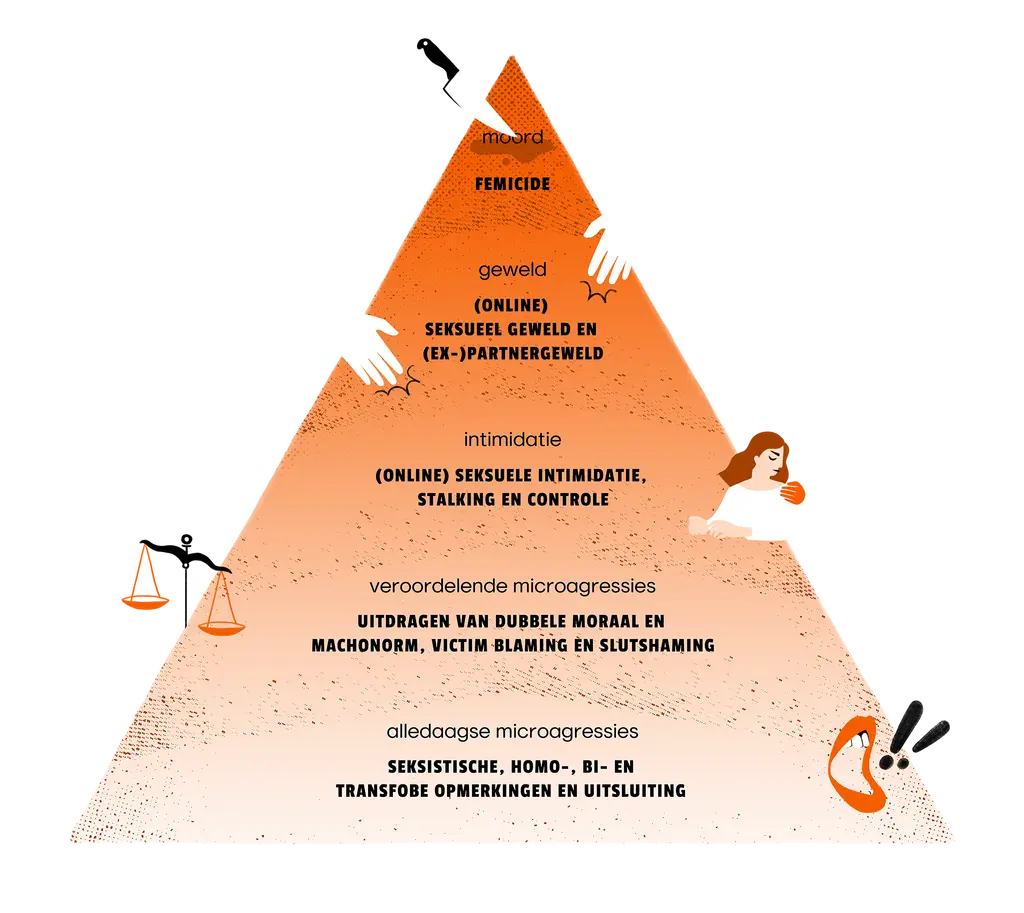
Pyramid of Violence
The pyramid is based on scientific theories about the relationship between "lighter" and "heavier" forms of gender-based violence. Thus, the "lighter" forms of violence from the lower layers of the pyramid provide a breeding ground for the "heavier" forms of violence in the upper layers. Thus, if we want to prevent gender-based violence, we must intervene in all forms of violence, including the "lighter" ones. A sexist, gay or transphobic "joke" or comment may seem harmless, but it is part of a harmful system.
The handout takes you step by step, through all the layers of the pyramid of violence:
Everyday microaggressions: sexist, gay, bi and transphobic comments and exclusion.
Condemnatory microaggressions: propagation of double standards, victim blaming, slutshaming and macho norm.
This layer involves not only comments that confirm stereotypes, but also negative judgment.Harassment: (online) sexual harassment, stalking and control.
In this layer, it goes from negative judgment to (online) transgressive behaviour.Violence: (online) sexual violence and (ex-)partner violence.
In this layer, the cross-border behaviour has progressed to actual violence.
At each step you will find advice on how to act, substantiation and a glossary of terms.