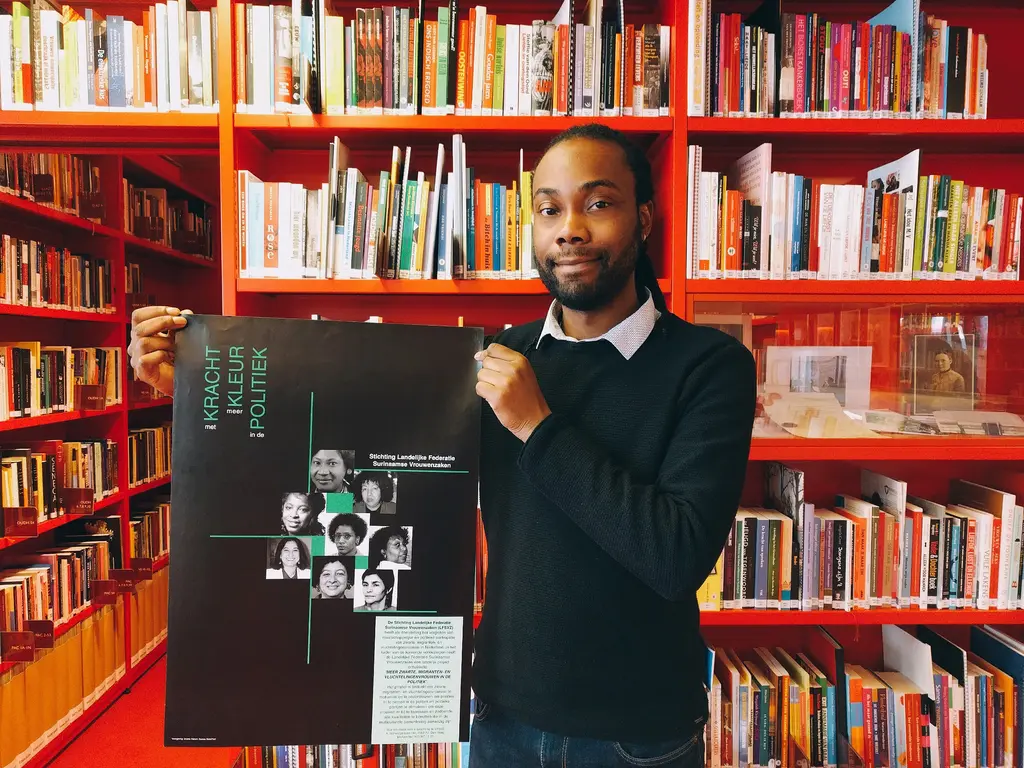
Atria asked four people to highlight a special collection piece from the archives of black women (movements) who have done important work against the establishment. In this blog, Simion Blom (GroenLinks bestuurder stadsdeel Zuidoost Amsterdam) highlights a poster from the Stichting Landelijke Federatie Surinaamse Vrouwenzaken. This organisation had started a project in the 1990s to encourage political representation of women of colour.
Atria asked four people to highlight a special collection piece from the archives of black women (movements) who have done important work against the establishment. In this blog, Simion Blom (GroenLinks bestuurder stadsdeel Zuidoost Amsterdam) highlights a poster from the Stichting Landelijke Federatie Surinaamse Vrouwenzaken. This organisation had started a project in the 1990s to encourage political representation of women of colour.
Campaigning for inclusive politics
The 2018 municipal elections saw campaigns to get more women into municipal councils. The Vote for a Woman campaign clearly paid off in Amsterdam. In Amsterdam, almost 40% of the candidate councillors were women. Ultimately, women are in the majority after the elections: 23 of Amsterdam's 45 councillors are women. This is the first time in history. The college of aldermen and mayor also consists of more women than men, and Amsterdam has a female mayor for the first time. Elsewhere in the country, women are still heavily underrepresented in municipal politics.
Political representation of women of colour
2019 marks 100 years since women were also allowed to vote. 100 years later, there is still no full representation of women in politics and administrative positions. For black, migrant and refugee women, representation is still much less than it should be based on population composition. This is precisely where more attention needs to be paid. A special campaign, for instance, but now focusing on women with a migrant background.
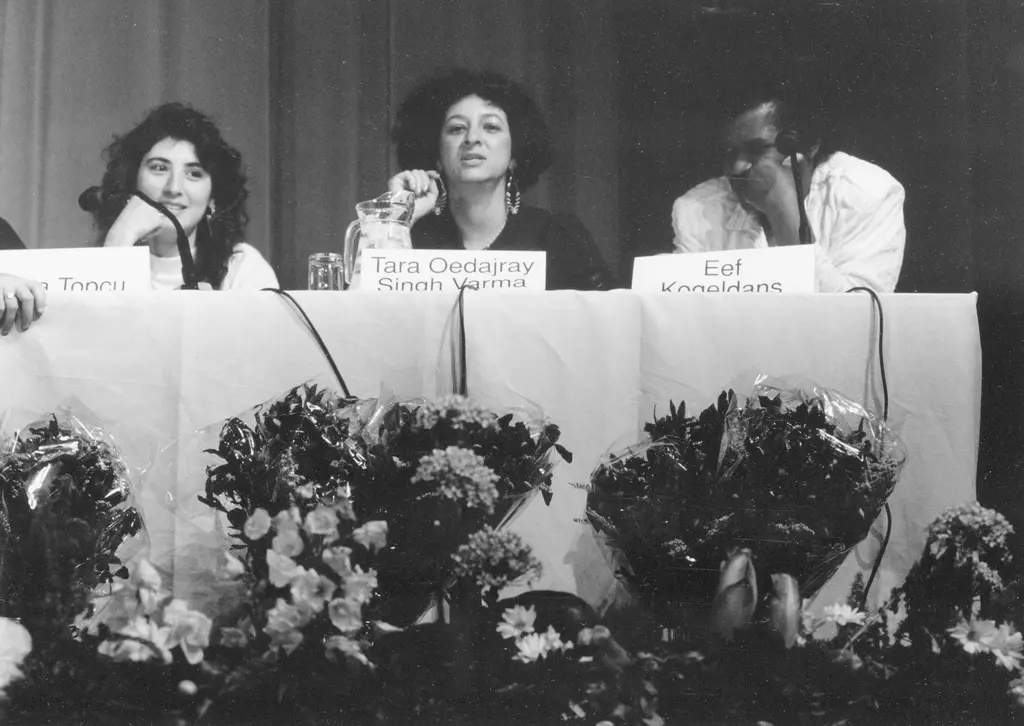
In Atria's archives, I found a poster from the mid-1990s. A poster as part of a campaign to get more women of colour into politics. On the poster, I see a good acquaintance of mine: Tara Oedayraj Singh Varma (LinksAkkoord, later GroenLinks). Tara is special for several reasons. In 1986, she was one of the first councillors with a migration background to be sworn in in Amsterdam. In 1994, she became the first woman from a migration background to be installed as a member of parliament.
The political seed was planted at the age of 13, after she read Anton de Kom's book We slaves of Suriname. From then on, she would become more interested in inequality issues and communism. At 17, she left for the Netherlands, otherwise she would be married off. She managed to flee with the help of her mother. She became politically active and campaigned for a Dutch boycott of South Africa at the time of apartheid.
The importance of role models for inclusive representation in politics
In the House of Representatives in 2018, for the first time in decades, no one from a Caribbean, Surinamese or African background sits in the House. According to some, it has to do with the fact that Surinamese or Caribbean Dutch are less problematic in the media and in politics. Political parties are said to overlook the group more as a result.
Tara Singh Varma says of the current political representation of women of colour: "In national and local politics, you see that Turkish and Moroccan Dutch are better represented than Caribbean or Surinamese Dutch. In the Lower House, we can be proud of Khadija Arib. She is the figurehead for what women with a migration background can achieve. And she does it well. Too many have little perspective and a role model is important to see what is possible.
There are reports that we (Surinamese-Dutch) don't go to the polls much. I think parties rely on that. People do not recognise themselves in politics or feel they are not taken seriously. I think the Zwarte Piet discussion is also a reason. People are angry. About how we are treated. But this is precisely why we have to claim our position and do get involved in politics. Those who are not there, are not seen."
Tara left politics in 2001 because of mental health problems. She is - anno 2018 - doing well now. She is still working in various ways to increase political awareness and political representation of women of colour. For instance, she coaches women who have political ambitions and makes programmes on local radio in Amsterdam.
Women like Tara have paved the way for people of colour in Dutch politics
The latest Vote for a Woman campaign has demonstrated the effectiveness of supporting women who have political ambitions. Women like Tara have paved the way for people of colour in Dutch politics. Especially now, 100 years after the introduction of women's suffrage, we need to push forward. For women of colour, it is all the more true that they need the support, given the strong underrepresentation. It is crucial that upcoming campaigns explicitly speak out in favour of women of colour who have political ambitions. The gender balance in the Amsterdam council is exceptional. And at the administrative and provincial level, there is still a whole world to be won in the Netherlands. Our entire society benefits from full representation. Representation does not happen automatically: it is up to us to achieve an inclusive reality.