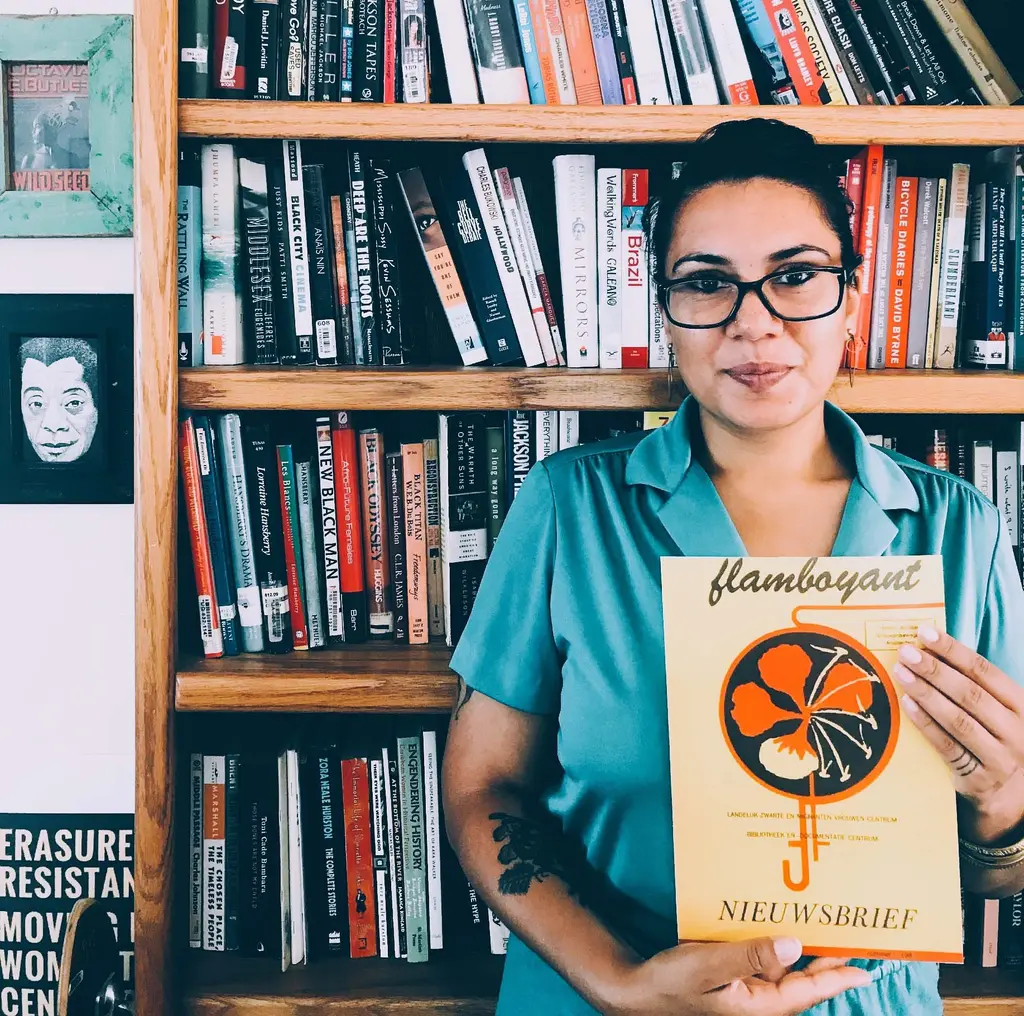
Atria asked four people to highlight a special collection piece from the archives of black women (movements) who did important work against the establishment. In this blog, curator, researcher and writer Chandra Frank highlights the newsletter of Flamboyant, the National Black and Migrant Women's Centre, Library and Documentation Centre in Amsterdam (1986 to 1990).
Atria asked four people to highlight a special collection piece from the archives of black women (movements) who did important work against the establishment. In this blog, curator, researcher and writer Chandra Frank highlights the newsletter of Flamboyant, the National Black and Migrant Women's Centre, Library and Documentation Centre in Amsterdam (1986 to 1990).
Singel No 260: The former headquarters of Flamboyant [1], the National Black and Migrant Women's Centre, Library and Documentation Centre in Amsterdam. No doubt, I passed by this address several times without having any idea of the history of this location. Reading Flamboyant's newsletters, and talking to former members such as Troetje Loewenthal, Kamala Kempadoo, and Cisca Pattiphilohy, as part of my doctoral research [2], revived Flamboyant. Atria has a number of Flamboyant newsletters in its collection, and personal archives of women who were active in Flamboyant, such as Tania Leon. As the first national documentation centre for so-called ZMV women [3], Flamboyant has played a historical role that too often remains underexposed.
Flamboyant's newsletters are fascinating records that give insight into the activities the organisation undertook. There were courses like Position of Black Women in the Netherlands/Racism, black literature workshops led by Audre Lorde, political meetings with ANC women like Ellen Kuzwayo, and meetings on the interests of sex workers of colour. Many of these topics and discussions are still relevant in the Netherlands.
Flamboyant shared space on the Singel with other important organisations in the ZMV movement. Such as the Moroccan Women's Movement, the Pakistani women's organisation Jaag, and Tres Oemas, the black women's film and video collective.
Flamboyant grew out of the need for a library and documentation centre by and for black migrant women. The lack of a library for ZMV women and specialised information services was a major point of struggle for ZMV feminists in the 1980s. Many white institutions did not document from the point of view of black women so materials were structurally neglected and not adequately documented. An extensive report by Cisca Pattiphilohy describes that in 1985, the gender equality Policy Coordination Directorate initially did not want to fund the project. The reason was that the government could not imagine the need for libraries and archives that would focus on black women's literature.
"Surely there will be literature relevant to you in the many public libraries"
Eventually, Flamboyant managed to get a grant and publish the Black women's bibliography with titles relevant to ZMV women. After about five years, the women could no longer stay in the premises on the Singel due to a lack of subsidy. The organisation moved and continued to operate under the name Zami, after Audre Lorde's book of the same name. The Flamboyant newsletters show that information and documentation by and for black women and women of colour is still an important feminist issue.
Nuts
[1] The name Flamboyant is a reference to the tropical plant according to the newsletter. This tropical plant blooms with red flowers making it appear that the tree is on fire. The description indicates that the Flamboyant (the tree) will not be tamed in the climate of the Dutch living room.
[2] My PhD research at Goldsmiths Univerisity looks at the role of feminist and lesbian archives of black women and women of colour in a transnational context.
[3] The term 'ZMV' (Black, Migrant and Refugee) is no longer in use. See Kaleidoscopic Visions for the history of the movement, the term, and the use and well-founded criticisms of the use of 'political black'.