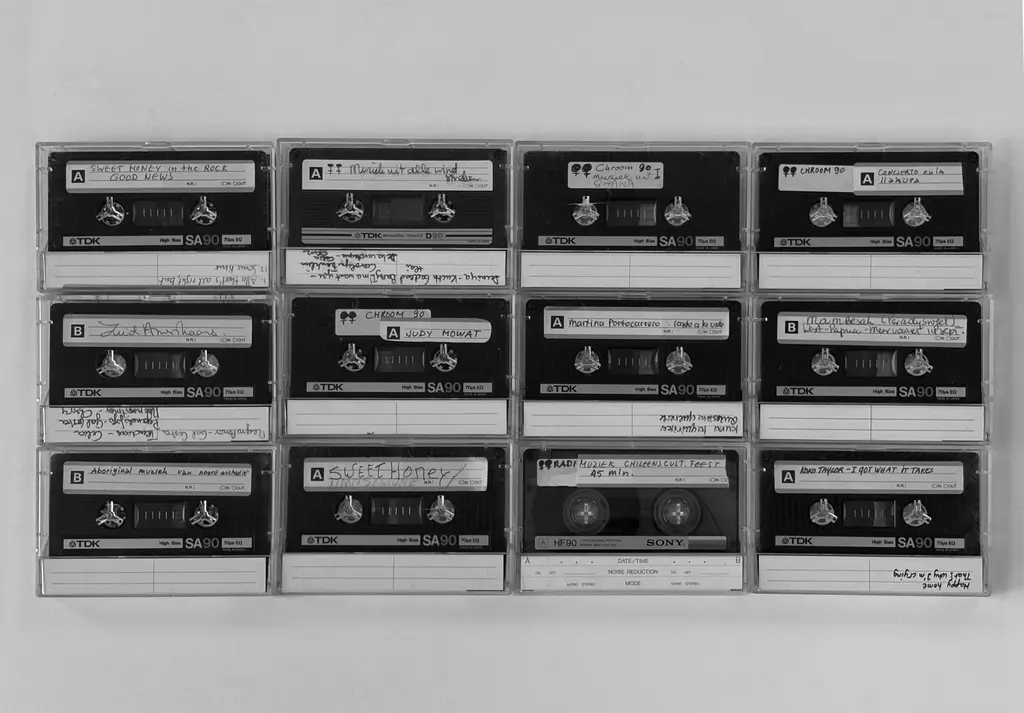
Atria asked four people to highlight a special collection piece from the archives of black women (movements) who did important work against the establishment. In this blog, photographer, artist and writer Angela Tellier highlights broadcasts from Black Women's Radio (1984 to 1987).
Atria asked four people to highlight a special collection piece from the archives of black women (movements) who did important work against the establishment. In this blog, photographer, artist and writer Angela Tellier highlights broadcasts from Black Women's Radio (1984 to 1987).
Cassettes full of Black Women's Radio history
The archive of The Black Women's Radio is a meticulously maintained collection of minutes, drafts, music lists and recordings of broadcasts. Co-founded on 9 September 1984 by Tineke E. Jansen. A station for a target group that until then had been forgotten or ignored. With the help of grants from the Mama Cash fund, The Black Women's Radio - parallel to The (White) Women's Radio - saw the light of day. However, with a short lifespan. In 1987, both White Women's Radio and Black Women's Radio were permanently disbanded.
Yellowed notebooks and old cassette tapes
For an afternoon, I buried myself in this time capsule. I leafed through yellowed pages of notebooks and studied music lists and suggested themes within the programming. Current affairs, conferences and women's actions were covered. But music, books and films also received attention. Most interesting are the old broadcasts on cassette tapes, which immediately give you a clear impression of the station.*
For a long time, the radio landscape was a monotonous one, dominated by white men. Women were scarce on radio. It was claimed that the public did not like listening to a woman's voice. The male voice was preferred.
Coming from a visual field, I find this view interesting. In most visual communication, a woman's presence is (very) welcome. But when it comes to the female voice, that presence is less appreciated both figuratively and literally. Which, by the way, in my opinion has nothing to do with whether or not a woman's voice is (content-wise) attractive to the listener, but mainly has to do with what is considered a standard by prevailing standards. In this case, it was once determined that a man's voice not only has more valuable information to provide, but is also more pleasant to listen to than a woman's.
An on-air platform of their own
These women created their own platform, entered the airwaves and formed a cluster centred on information sharing, entertainment and politics. The station was educational, activist and gave a stage to black women from different cultures.
I listen to how classic Indonesian folk tales and Afro-American jazz alternate with coverage during protests at the Embassies in The Hague. Conversations about how the divide between two cultures works to the detriment of developing one's own identity and the cry for more culture-focused education to prevent intergenerational alienation.
Protests against Black Pete
I also hear how a reporter attends protests against the appearance of Black Pete during the annual Sinterklaas entry, and witness how her arguments are brushed aside with irritation into something unimportant. 'But this is nothing new,' the woman says.
"I did expect this. But we are not giving up"
I put the cassette back in its holder and consider that everything I listened to is still current. I look at the year of the recordings. 1984. For more than 34 years, people have been fighting against the racist caricature Zwarte Piet. Resistance still exists and understanding is often still far away.
Black Women's Radio is a valuable archive to better understand where people come from and where they might be going. It is a piece of history with wonderful stories and music by female artists. Above all, it is an archival piece that gives insight into the longevity of change.
The roots of change
Is there also change in the current radio landscape? Several women have proven that a woman's voice attracts listeners as much as a man's. Consider Angelique Houtveen, a woman who has her own afternoon show. Houtveen breaks the barriers of gender and colour with her talent. Her presence gives the channel a breath of fresh air and allows the audience to connect with the music of artists and topics that would not have had the attention before.
In terms of full diversity and acceptance, we are far from there. Prior to the entry of St Nicholas in 2018, it was announced by various media that St Nicholas would be accompanied by an entourage of exclusively sooty coloured Pieten. In the end, unfortunately, there were Black Pieten at the entry after all. But the beginning is there. The roots of this beginning reach deep into history. It is important to know where we come from. The ground we stand on now will become more solid for future generations, just as previous generations built a foundation for us.
*Cassettes can't be listened to in the library now.