Nieuwe Europese cijfers: gendergerelateerd geweld tegen vrouwen

A recent, large-scale European study once again shows that violence against women is a major social problem. One in three women in the European Union has experienced physical or sexual violence in her lifetime.

As a knowledge institute in the field of gender equality in the Netherlands, Atria interprets the latest scientific data on the extent of gender-based violence in Europe and the Netherlands. Senior researcher Paula Thijs places these European and Dutch figures in context and, where possible, makes a comparison with figures from ten years ago.

Gender-based violence is violence that affects someone because of someone's sex or gender. Although violence affects people of all genders, not everyone experiences violence equally. The degree and impact of violence can vary based on gender of the victim and perpetrator, their relationship and the type of violence.

Research shows that women are more likely than men to be victims of sexual violence, domestic violence and violence by a (former) partner. Because the perpetrator is more often someone they know, it can be difficult for victims to talk about their experiences and seek help or report them to the police. Therefore, women's experiences of violence do not show up as well in official statistics such as police records. By anonymously asking women themselves about their experiences of violence, particularly sexual violence, domestic violence and (ex-)partner violence, we can get a better picture of women's experiences of gender-based violence.

New European figures

On Nov. 25, 2024, EIGE (European Institute for Gender Equality), FRA (European Union Agency for Fundamental Rights) and Eurostat published new figures on violence against women in the 27 member states of the European Union. The data were collected from 114,023 women between the ages of 18 and 74 in the EU between 2020 and 2024. The last time such figures were collected and published was in 2014. That was the first time a large-scale, comparative study was conducted on the scale of violence faced by women and girls in Europe.

The new figures show that:

  • 1 in 3 women in the EU has experienced physical or sexual violence in her lifetime

  • 1 in 8 women have experienced sexual violence, including rape, by someone other than a (former) partner

  • 1 in 5 women have experienced physical or sexual violence by a partner, neighbor or roommate

  • 1 in 3 women experienced sexually transgressive behavior at work; this applies to 2 in 5 young women

  • just over 1 in 8 women who experienced violence reported it to the police

In 2025, Eurostat, FRA and EIGE will publish a comprehensive research report on gender-based violence in Europe and its consequences.

Violence against women in the Netherlands

What about violence against women in the Netherlands? In the Netherlands, 4184 women participated in the European survey. This gives a representative picture of the experiences of women in the Dutch population aged 18 to 74.

Image

Some striking results for the Netherlands:

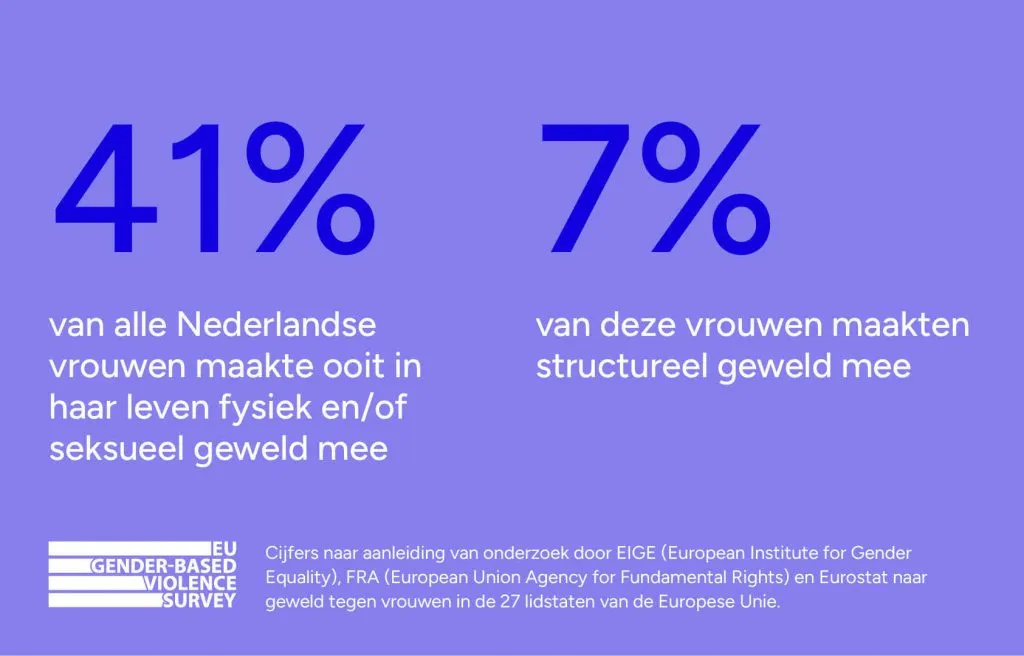
  • 41% of all women experienced physical and/or sexual violence at some point in their lives. In 7% the violence was structural.

  • 1 in 3 women have experienced sexual violence in her life.

  • Almost 1 in 6 women in the Netherlands has experienced physical and/or sexual violence by an intimate partner or ex-partner.

  • 1 in 3 women have experienced psychological violence by an intimate partner or ex-partner.

  • 1 in 5 women has experienced physical and/or sexual domestic violence in her life.

  • Over a quarter of women experienced sexual violence by someone other than a (former) partner since the age of 15.

  • 1 in 14 women in the Netherlands has been raped by a non-partner since the age of 15.

  • 1 in 5 women have ever experienced stalking.

  • Over 40% of women in the Netherlands have experienced sexual harassment at work in her lifetime.

Where possible, Atria makes a comparison with the situation in 2014 and with recent figures from the Prevalence Monitor on Domestic Violence and Sexual Transgression 2024.

Violence against women is common in the Netherlands. 41% of the women interviewed for the European study have experienced some form of violence in their lives. This includes a sum of physical violence or threats and sexual violence, regardless of the severity of the incident and the type of perpetrator. This is higher than the EU average: of all women in the 28 EU countries, 30.7% experienced physical and/or sexual violence.

3.7% of women in the Netherlands experienced physical and/or sexual violence in the past year. For 7%, the violence was structural, meaning it occurred repeatedly over a period of time.

Compared to 2014, the percentage of women who have ever experienced violence in 2024 is slightly lower: in 2014, 45% of Dutch women interviewed said they had ever experienced physical or sexual violence. We cannot determine with certainty whether this is a slight decrease in violence or whether it is due to differences in the group of women interviewed.

The figures from the recently published Prevalence Monitor differ from the European picture. Figures from the Prevalence Monitor show that 24% of women aged 16 or older have ever been victims of domestic violence and/or sexually transgressive behavior (compared to 12% of men). The fact that the results are higher in the European study may have several reasons, including differences in the method of data collection, differences in the sample or differences in the questions and definitions.
Gender-based violence against other genders

The EIGE, FRA and Eurostat research only looks at violence against women. This leaves gender-based violence against other genders out of the picture.

However, multiple studies show that violence against LGBTQ+ individuals is often even higher than violence against women in general. For example, the HGSGG 2024 Prevalence Monitor shows that sexual transgressive behavior is still much more common among bi-plus women (34%), gay men (25.7%) and gay women (17.3%), than among heterosexual women (13.7%) and heterosexual men (6.1%).

People's experiences also differ based on other personal characteristics besides gender, such as age, disability, sexual orientation and ethnicity, and the intersections between them. There is increasing attention to these intersections, but more research is needed to capture these figures.

Conclusion

New, European comparative figures on gender-based violence show that gender-based violence is relatively common in the Netherlands compared to other European countries. Especially in the field of sexual violence. This is confirmed by other Dutch figures. Home and work are not always a safe place for women. Perpetrators of (sexual) violence are often someone they know, such as a (former) partner, family member or acquaintance. Many women in the Netherlands experience sexual harassment in the workplace.

The European figures provide insight into the large scale of violence against women, a form of gender-based violence. However, due to differences in data collection methods, definitions and questioning, the figures cannot always be properly compared with national figures and over time. This underscores the importance of reliable and comparable figures to measure developments over time and the effectiveness of policies. More research is also needed to identify intersectional forms of gender-based violence.

Gender-based violence is a social problem and a violation of human rights. To counteract it, an integral and gender-sensitive approach is needed in which prevention, combating and support go hand in hand.

Prevention of sexual violence: Act4Respect

Atria is currently conducting research on the prevention of sexual violence and (ex-)partner violence. The Act4Respect-Unlimited alliance, a collaboration between Atria, Rutgers and COC Netherlands, works with young people and professionals to promote equal relationships among young people and focuses on sexual violence and (ex)partner violence directed against girls/women and lhbti+ persons and cyber violence.

Atria has been collecting and managing resources on gender-based violence since 1935 and contributes to (inter)national research on its prevention.

News
Date
5 December 2024
Estimated reading time
Calculating...
Subscribe to our newsletter (in Dutch)

We use cookies to improve our website and analyze how it is used. You can choose to accept all cookies or customize your preferences.