Misogyny is often described as hatred of women. However, misogyny is not always easy to recognise, and the definition of misogyny is a matter of debate. Misogyny has many facets and manifests itself in various areas of our (daily) lives: online, in private life, in politics and in the media. In this article, we take a look inside the ‘black box’ of misogyny to gain a better understanding of its various forms.
Misogyny is often described as hatred of women. However, misogyny is not always easy to recognise, and the definition of misogyny is a matter of debate. Misogyny has many facets and manifests itself in various areas of our (daily) lives: online, in private life, in politics and in the media. In this article, we take a look inside the ‘black box’ of misogyny to gain a better understanding of its various forms.
What is misogyny?
The Van Dale dictionary defines misogyny as ‘hatred of women’ (Van Dale online, 2026). The word ‘misogyny’ comes from Ancient Greek: miseo ( μισέω = to hate) and gyne ( γυνή = woman). But would a man who hits a woman say of himself that he hates (all) women? He surely has a caring mother, a lovely daughter or a cool female colleague. Patriarchal gender norms are full of love for submissive women who serve men. In Trump’s words: ‘I have many female executives [working for me]. They do an excellent job. I pay them a huge salary. They make money for me.’ (Viebeck, 2015).
If misogyny is understood solely as hatred of women, then almost no one appears to be misogynistic. Kate Manne, a philosopher and feminist professor at Cornell University and author of the acclaimed book *Down Girl: The Logic of Misogyny*, argues that misogyny must be defined as a systemic phenomenon. In other words, misogyny does not manifest itself in isolated expressions by individuals but is a phenomenon deeply embedded in structures, institutions and the prevailing culture of society. According to Manne, we must view misogyny as the enforcement arm of a patriarchal order (Manne, 2016). By this she means that misogyny is the mechanism that disciplines anyone who questions the traditional gender order or challenges power relations.
Not all women are confronted with misogyny to the same extent or in the same way. For women of colour, women belonging to (religious) minorities, trans women, or women who do not look or behave in a traditionally feminine way, misogyny can be intertwined with racism, religious discrimination, transphobia or other forms of exclusion. From an intersectional perspective, these forms of discrimination cannot be viewed in isolation from one another, as they accumulate and reinforce one another (Loewen Walker 2024).
Misogyny versus sexism
Professor Kate Manne distinguishes between misogyny and sexism: misogyny perpetuates, sexism justifies. Sexism is an ideology that presents male dominance over women as ‘natural’. For example, there is the notion that women are by nature more caring than men, whilst men are better suited to being breadwinners. Misogyny is, as it were, the aggressive overseer, guardian and enforcer of this ideology. According to this line of reasoning, as long as a woman remains obedient, subservient and caring, a man has absolutely no reason to hate women. But if a woman ‘doesn’t know her place’, the misogynist man (or woman) will call her to order. In other words, if a woman transgresses the patriarchal division of gender roles, the misogynist man takes issue with it. This happens, for example, when women in political leadership roles are verbally abused, intimidated or not taken seriously. Within misogynistic logic, a man who hits a woman must surely have a reason for doing so: she may have provoked him (was she having an affair?), treated him unkindly (did she reject him?), worn provocative outfits (was she trying to seduce him or other men?) or pursued selfish career ambitions (did she want to earn more?).
Misogyny and gender-based violence: a long history
Whilst sexism provides the breeding ground for gender-based violence, misogyny is the verbal, online or physical enforcement of it. Misogyny ensures that women remain in a subordinate position in relation to men, including through (physical or sexual) violence. In the Netherlands, more than 40 per cent of women experience physical or sexual violence at some point in their lives (EIGE, 2024), and worldwide, this figure stands at one in three women. Gender-based violence takes many forms, ranging from street harassment and everyday sexist microaggressions to sexual harassment and femicide.
Misogyny is, of course, not a recent phenomenon, but is deeply rooted in Western history and culture. As far back as Roman times (2nd century AD), the pater familias (the male head of the household) possessed the jus corrigendi: the so-called right of correction or disciplinary authority (Buono, 2026). This right could be exercised both verbally and physically and applied to all family members – wives, children and slaves. It was a legally and culturally recognised affirmation of male superiority. With variations and nuances, this male authority over women and children persisted well into the twentieth century. What happened behind closed doors was regarded as a private matter. Women often had little economic and legal autonomy and had limited opportunities to escape violence. According to historian Savien Hoeks (2024), the witch hunts between the fifteenth and seventeenth centuries are a striking historical example of systematic violence against women. Hundreds of thousands of women were accused of witchcraft and persecuted, often resulting in their deaths (around 60,000 in Europe). These were often single women, widows, midwives, herbalists and other women who deviated from the gender norms of their time.
In the 1950s and 1960s, women’s position in society gradually changed. Women began to play an increasingly visible role in public life, partly due to their rising levels of education and participation in the labour market. Women began to assert their rights more emphatically. In 1956, partly thanks to the feminist and Member of the House of Representatives Corry Tendeloo, the ban on married women working in the civil service was abolished (Tijhaar, 2023). Power relations between men and women, both within and outside the family, were openly challenged during the second wave of feminism; on the streets, in the media and in politics. Violence against women was no longer viewed in public debate as an individual or relationship-based problem, but as a structural social issue, about which more and more knowledge was being gained. This social and political pressure led to a legal turning point in 1991: the criminalisation of marital rape. Until then, forced sex within marriage had not been considered a criminal offence; the husband effectively had control over his wife’s body. Yet, even decades later, misogyny and gender-based violence remain deeply rooted in Dutch society. At the same time, misogyny is taking on new forms, partly under the influence of technological developments.
Misogyny online
Over the past few decades, the public sphere has increasingly shifted towards the digital realm. Misogyny is also evident there. The more visible women are online – in politics, public debate or the business world – the more frequent the attempts to undermine them. A large-scale study by Plan International (2025) shows that women and young girls are disproportionately likely to be victims of online hate and harassment compared to (young) men. Globally, 58 per cent of all girls aged between 15 and 25 experience online harassment.
Professor Emma A. Jane argues in *Misogyny Online: A Short (and Brutish) History* (2017) that whilst the internet did not invent sexism, it has certainly amplified and spread it on an unprecedented scale. According to her, misogyny has, as it were, gone viral as a result. Online misogyny manifests itself primarily in verbal attacks (such as verbal abuse, threats of rape or even murder), but the consequences extend far beyond the digital realm. Victims report, amongst other things, anxiety, stress, sleep problems and feelings of insecurity, both for themselves and for their loved ones.
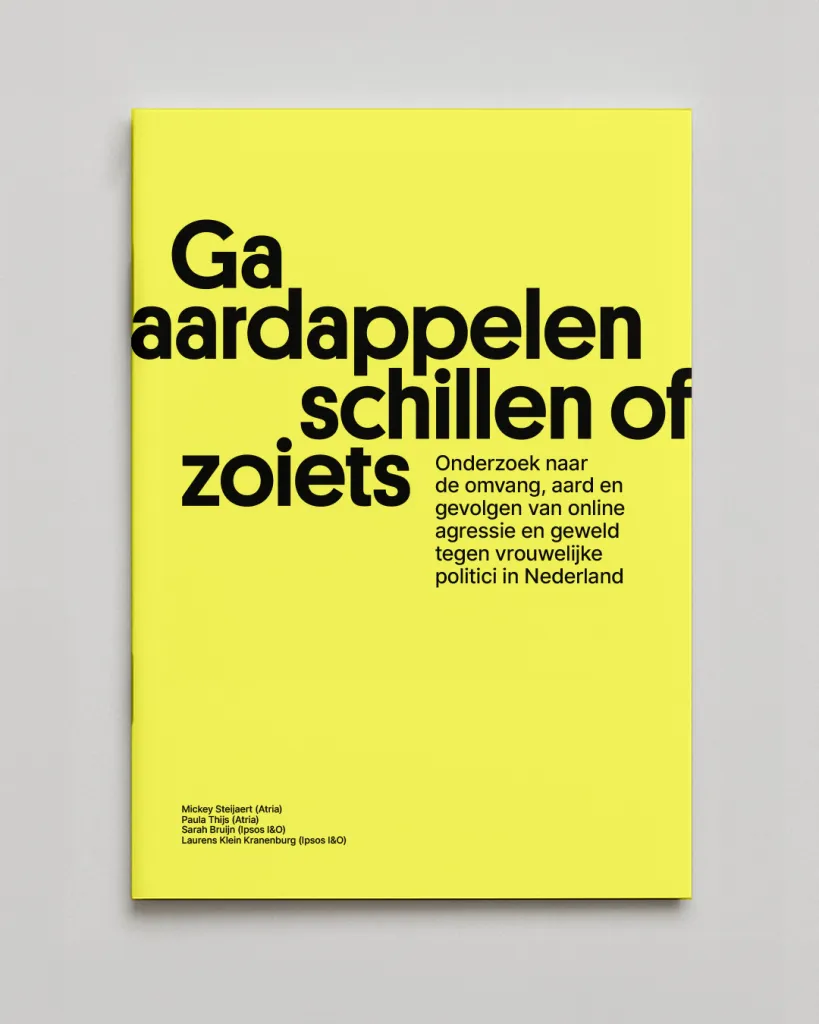
One group of women who are particularly hard hit by online hate are female politicians. Research shows that online hate and violence against female politicians in the Netherlands are widespread: approximately ten per cent of tweets directed at female politicians contain hate or aggression, with women of colour being the most frequently targeted (Saris and van de Ven, 2021). Research by Atria and Ipsos I&O from 2022 showed that 47 per cent of female politicians in local government in the Netherlands had experienced online aggression or violence in the past twelve months, compared with 35 per cent of men. As a result, one in ten female politicians is considering giving up their political activities.
Research involving focus groups with young women with political ambitions shows that witnessing this violence usually has a deterrent effect. Participants cite online and offline threats, constant scrutiny and being judged on appearance rather than substance as major obstacles. Women of colour, in particular, experience a combination of sexism and racism (Runderkamp et al. 2023).
In her research report *Monetising Misogyny* on online hate against women in politics, Lucina Di Meco (2023) concludes that this form of misogyny not only affects individual women but also has broader democratic consequences. Online hate influences women’s willingness to be visible in the public sphere, to speak out freely and to participate actively in public debate.
Misogyny and the manosphere
A recent phenomenon through which misogyny manifests itself and spreads online is the so-called ‘manosphere’. This is an umbrella term for a collection of online communities, networks and groups in which men interact with one another and consume and share content from so-called ‘manfluencers’ (Ardon, 2025). This content often focuses on topics such as masculinity, gender relations, wealth, success, fitness and self-development. Within the manosphere, there is a prevailing belief that feminism and the gender equality of women have led to a loss of male status and influence. Men’s frustration at the loss of power and status in society has found an online platform that has continued to grow since the 2000s. From this perspective, men are encouraged to resist these social developments and to strive to restore traditional power relations between men and women. The breeding ground for the manosphere is a varied mix of misogyny, hegemonic or toxic masculinity, and homophobic and transphobic views (Dekker et al., 2025). Hegemonic masculinity is the ideal of masculinity in which traits such as dominance, authority, and physical or social strength are valued and placed above femininity. Within these beliefs about masculinity, there is also a hierarchy of what is considered very masculine or not masculine at all. Toxic masculinity refers to the harmful excesses of this ideal, such as aggression, the suppression of emotions and vulnerability. Although the relationship between misogyny within the manosphere and physical violence requires further investigation, recent studies suggest that a growing number of perpetrators of sexual violence and femicide have been exposed to ideas and networks from the manosphere (Regehr, 2022; Ministry of Justice, 2019).
Young men constitute a key target audience for algorithmically driven ‘manosphere’ content. Research shows that social media, algorithms and AI are misogynistic and reinforce existing gender stereotypes, unequal power dynamics and sexism (Copley et al., 2025). For example, on social media, boys can, within a few clicks, find themselves exposed to dating coaches, crypto-influencers and other content creators who spread misogynistic or anti-feminist views (Goldberg et al., 2025). Research also suggests that certain social and personal circumstances increase susceptibility to ‘manosphere’ content. Factors such as dropping out of school, loneliness, problematic alcohol or drug use and mental health issues are regularly linked to the appeal of these online communities. Researchers at Atria are currently conducting research into this topic, in collaboration with colleagues from Rutgers and COC Nederland, as part of the Act4Respect programme.
Misogyny, ‘gender ideology’ and the anti-gender movement
Misogyny is often directed at women, but not exclusively. As a mechanism for enforcing a patriarchal and binary-heteronormative order, misogyny is directed not only against women’s gender equality, but also against LGBTI+ gender equality and so-called ‘gender ideology’. ‘Gender ideology’ is a pejorative umbrella term coined in misogynistic circles, used to portray a range of emancipatory developments (such as gender equality, feminism, sexual and reproductive rights, and LGBTI+ gender equality) as a threat. For misogynists, only men and women exist – with nothing in between – and the balance of power between them should remain traditionally hierarchical, with women subordinate to men. In their view, gender equality and feminist movements threaten traditional family structures, conservative gender roles and patriarchal power relations (Korolczuk, 2025).
There is an international movement and a coordinated network of groups that oppose gender equality and diversity: the anti-gender movement, which seeks to protect traditional, binary and heteronormative roles and clear distinctions between men and women. The anti-gender movement and its ideology have existed since the 1990s and have become increasingly visible and mainstream through the internet and social media.
Research shows that the anti-gender movement operates within a framework in which women, feminists and LGBTI+ people are portrayed as a threat to (traditional, patriarchal) society (Wolf and Hell, 2022). Misogyny is not merely a side effect of anti-gender politics, but a mechanism through which women who challenge existing power structures are disciplined, stigmatised or excluded from public debate.
The anti-gender movement, in which the Vatican has played a significant transnational role since the 1990s, has grown in recent decades into a well-organised and internationally funded political force. The movement unites a diverse range of conservative, religious and far-right actors in opposition to what they refer to as ‘gender ideology’ and the alleged ‘LGBTI+ lobby’.
Right-wing populist leaders often act as the public spokespeople for this agenda. A well-known example is Giorgia Meloni. During a speech in 2019 criticising the progressive government that was open to LGBTI+ rights, she declared: “I am Giorgia, I am a woman, I am a mother, I am Italian, I am a Christian. And they will not take that away from me!” (Meloni, 2019, author’s translation). With this message, she presented herself as a strong woman, but at the same time as the embodiment of traditional norms surrounding femininity, motherhood, family and national identity. A few years later, her government appointed an ultra-conservative ‘Minister for the Family, Birth Rates and Equal Opportunities’, Eugenia Roccella, who works closely with the Vatican.
Once again, Kate Manne’s perspective helps to explain how misogyny operates, including within the anti-gender movement. Misogyny is not simply hatred of women (Meloni herself is proud to be a woman), but the mechanism by which patriarchal norms are enforced. The anti-gender movement is in power in Italy (and many other conservative countries); misogyny is its language and its disciplinary power (Lavizzari, 2025).
Conclusion
The many faces of misogyny show that this phenomenon is not limited to hatred of women. Misogyny is evident in reactions to women who do not conform to traditional gender norms in their lives or behaviour, in online harassment, in the manosphere and in movements that portray gender gender equality as a threat. It is time for the Van Dale dictionary to update its definition of misogyny to reflect this reality.